014 - Zach Taylor
the Dad That She Thinks I Am
A profile of Zach Taylor, owner, Melania Corporation
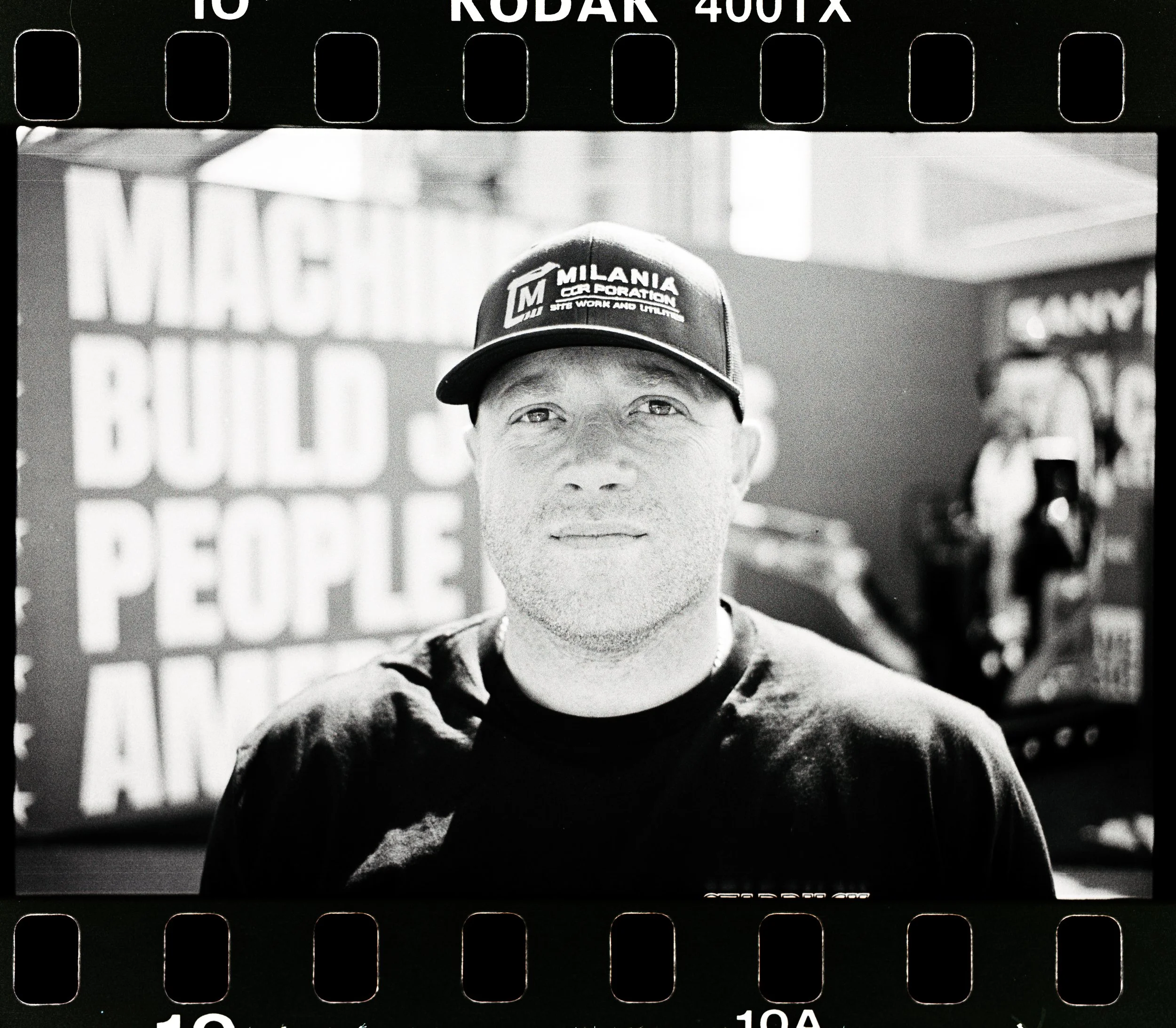
Portrait of Zach Taylor in Las Vegas, Nevada at ConExpo 2026. Shot on 35mm Kodak Tri-X 400 film with Leica R6.2.
Zach Taylor named his company after his daughter.
"I own a small excavating company that I just started last year. Melania Corporation. Named it after my daughter. So things have been going well. Starting to pick up some better contracts and buying some equipment this year. It's getting exciting."
The company is new. The career isn't. Zach is 38, and he'd worked his way from a shovel up to big equipment long before he ever put his own name on a truck, including a stretch in the union.
"I spent five years in Boston. Well, six years in the union, five years in Boston. I just got tired of the drive, but my company got bought out. There was a lot of politics going and stuff. I've always done side work, so I wanted to go out on my own. And I'd always had another business partner and other ventures that I had. And finally I was just like, 'No, I need to do this.' And then I was at Trimble Dimensions two years ago and Dane Cotten called me a pussy, and well, here we are."
"Impeccable business advice. If you've ever thought about starting a business, just let somebody bully you into it and hope for the best."
He's laughing hard by the end of that one.
Everybody Likes Yellow Iron
The story of how Zach fell in love with the industry is similar to a lot of others. It started at a young age, with a fascination with machines.
"When I was really little, I grew up next to an excavation company, so I used to walk the dog with my dad and I liked the diggers and the buckets and excavators and loaders and all that stuff. So I'd always liked it and I always wanted to run an excavator. And when I got older, my buddy had a landscape company and he let me try this little Bobcat, like 50 or whatever. Damn near flipped the thing over like moving a log. But I was like, 'I want to know how to do this.'"
And it was always one specific corner of the industry that had his attention.
"When I looked at construction as a kid, it was like, you want to be in the diggers, you want to be in the loaders. The equipment always inspired me. It got me excited. So that's kind of how it started when I was little. I was never really interested in framing houses and roofing and stuff like that. Those are all great jobs, but everybody likes yellow iron."
Can't Sit Here With a Tie On
He didn't go straight into it. There was a detour first.
"I did go to college for marketing because I was still living the old basketball dream, but six foot white kids from New Hampshire that shoot threes are not rare. So that died when my eligibility was ending. And I was like, 'I don't really like what I'm doing.'"
He was 24, working his first job out of school in an inside sales office.
"I hated it. I didn't like the product I was selling. I didn't like sitting in an office. I didn't like dressing up every day. I didn't like that corporate sit down, 'here's your desk, here's your cubicle, you gotta contact this many...' And there's some people that that just drives them. Competitives. They always say athletes are good at sales because they're competitive and that's true in some cases. But for me, I didn't like that form of structure."
"Can't sit here with a tie on all the time. So kick that one off and go back outside."
He'd worked construction in the summers, but going back outside for good meant starting at the bottom of it.
"Started as a laborer, ran a shovel. They put me in a skiddy. Then I got into a loader. That was a big change. And then worked my way into excavation. Now I run big stuff. Sometimes."
Wanting to be outside is one of the most common answers you'll hear anywhere in this industry. Ask Zach about it and he answers it against the alternative he'd already tried.
"Just the fresh air. I mean, that's kind of a bland answer. But again, sitting in the office every day, looking at that computer screen, just staring out the window when you're bored, knowing I didn't want to do this. Outside, fresh air, sun's chirping. You get on a crew with a bunch of good guys and you're just out there busting ass and doing your thing and you got a nice day to do it in. For me, there's nothing better."
There's one kind of day in particular he'll take over any other.
"Let me cut a street open and tap into a water main on a nice 75 degree sunny day. 'Let's get dirty. Let's go do this.' That fires me up. It's my favorite part of construction. If I can cut a road open and ruin somebody's commute and just get down in there, throw the trench box in the hole, got to have the trench box as we know. Climb down the ladder and start working, running the machines, just being out in life, and seeing all of it."
I Want to Be the Dad That She Thinks I Am
Ask him how he keeps his head up when the work gets hard and he goes right back to the name on the company.
"I had a great job. I made good money. I had good benefits, but that's what it was. It was a job. I was never going to be able to be a superintendent. I was never going to be able to be any more than the equipment operator. And that's totally fine. But I wanted more. I have a daughter. I wanted more for her. I wanted more out of my life. So I named my company after her so that there's the days I want to quit, I remember why I started the business, and you just push through. That's the best answer I can give you. I want to be the dad that she thinks I am."
What the work demands, in his word, is commitment.
"It will push you sometimes to your absolute breaking point. But it's rewarding."
The reward mostly isn't something he gets to point at afterward. His part of the job is the part that gets covered up.
"If you look at any of these buildings, we have the job that nobody ever sees because when the building's done, everybody goes, look how beautiful that hotel is. Nobody's going to remember the water lines that went in, the sewer lines that went in, the foundation that was dug, the site leveling, all that. But you did all that hard work for this to be built. And there's a real sense of pride in doing good work and seeing projects come to life."
Owning the company changed him, and he can name exactly how.
"I've had to grow up a lot. And I'm 38. But I still consider myself 21. I like to go out and have a good time. I like to do fun things with my daughter. I like to go screw around in my boat with my friends if she's with her mom that weekend in the summer. But last summer I really had to prioritize, 'I need to get this job done. It's 87 and sunny and it's a Saturday. And this is a prime day to be out on the lake drinking cold boys. But I have to do this because this client has hired me. They have paid me my deposit and I gave them a job that I said I would turn over to them by this date. And today's the day that I go to work.'"
It shows up in the down time too, in what used to be dead hours.
"There's days that you sit on the couch and you're just doom scrolling on TikTok because your brain's mush. And that was cool when you worked eight, nine, 10 hours for somebody else and came home. But I've caught myself a lot of times being like, okay, 'what can I do for my business? What's something that needs to be done? What's something I'm putting off to tomorrow?' I can procrastinate with the best of them. But at some point you just have to make the decision that this is my focal point. When it's your responsibility to get paid, you have things you need to do. Your days do not end. Anybody that's an entrepreneur will tell you that."
"The maturization of me going from 'I'm a construction guy to I'm now a business owner.' I've noticed little things that I'm doing differently."
Trench Safety Tuesday
There's a second thing Zach is known for in this industry, and it started with a photograph.
"I saw this picture and I shared it. And there's this guy, they're like 12 feet down in somebody's backyard doing sewer. And he's just standing there looking up, holding the little dink shovel everybody likes. Somebody stood there and took a picture of him and then like five minutes later the thing caved in on him, and he died. And that was the last photo that anybody ever saw of him. And nobody on that job site had the wherewithal to be like, 'Hey, you should not be down there. That's actually a very dangerous position to be.' But they just walked up, took a cool photo, guy dies, and that was the end of it."
He posted it because of what usually happens next.
"When shit happens, whether it's a police officer gets shot, blue line goes up, everybody that supports the police shares that. And then the next day you get up in the morning and you carry on with your life because, 'that's sad and wrong, but I'm an accountant, so I'm going to go to the office after this and my life continues.' But for me, that is my life. It's every day something like that [trench collapse] could happen. And if you're an employer that doesn't give a shit, that was my point of the post. I was like, 'F you, you're a piece of shit contractor.' And I just went on like Twitter fingers, hit my post, went to bed and passed out, woke up in the morning."
"I don't have a massive following by any means, but it was like 500 re-shares, all these comments, likes, posts. Missy Scherber messaged me privately and was like, 'You should do this.' It just happened to be a Tuesday. She was like, 'You should do this every Tuesday and call it Trench Safety Tuesday because nobody takes a raw approach to it.'"
The rental houses run good training programs, he says. That wasn't the gap.
"Nobody was really doing like, 'this is my job and I'm going to say something about it.' She's like, 'You just got to keep running with that.' So I'm like, 'Yeah, you know what? Maybe I will.' So I started just sharing posts and then I was like, 'Well, I don't want to just be a Debbie Downer and be like, ah, another guy died. Another guy died.' But it was happening a lot. So in between, I try and share best practices. Because you don't know what you don't know. And to an extent, that's okay. If you're owning a business, if you do this work and this is the way you run your business, you should know these things."
"It's your responsibility to train the people so that you've got a culture of that in your company. But there's just people that don't care or they cut corners, they don't need a box, or they don't do this, or they don't do that. And it's all good until it's not. And it only takes a second and someone's dead."
A few years of that led to a speaking slot at ConExpo, a full room, and two friends of his who had been buried in trenches when they were younger telling their own stories.
"One of the guys takes like 32 pills a day. He can't take a direct flight anywhere. He can't stand for too long. He can't sit for too long. He can't lay down for too long. If his back goes out, it's three weeks. He's got a week in the hospital. He's got a week rehab, if you will, and a week to start to get back to his everyday life. And the second it happens again, the whole thing starts over. You can't get insurance. It's preexisting condition."
Asked what that impact actually looks like day to day, he describes both of them.
"Alex, they put him on basically like a medieval stretching board. And he can tell because certain parts of his body will start to get stiff because it's nerves pinching. And they'll strap him down and they'll literally pull and separate everything that's compacting. And then he goes to the chiropractor every other week and he lives with that. But like Gary, he says it's four flights for him to go home [from ConExpo]. And he doesn't do that because he wants to sit in airports, but he physically needs to get off the plane and walk around, does all these stretches. He wears certain braces to keep his hips compressed so that things don't just like roll out on him. He said for a 30 second decision, it's been 25 years of regret because he just decided to make a dumb choice. And it literally affects him as a parent. He's got daughters. Can't always go hiking. Can't always do this. Can't, because he'll just lay on his floor for like 25 minutes just to let everything settle down."
"So you hear about the people that died and you're like, that's a pretty easy one. Guy died, it's terrible. But the people that were rescued aren't the same and it's something that they live with for the rest of their life in a negative way. It affects everything that they do. Constant pain, constant discomfort, having to say no to things that normal people don't say no to. But it can be a lifetime of just paying for that choice. And that falls on the employer and it falls on whoever's in charge of the site that day to train people that don't know and to put people that do know in a position that they can make decisions to do the right thing."
He's got a long-term goal for it. Last year Shay Stutsman shut down Stutsman-Gerbaz for a day, dug up the backyard, and ran his whole company through hands-on stations in real dirt: rigging, setting a box, stacking boxes for deeper work, hydraulic shoring, classroom time in small groups. Zach wants to build something like that.
"I don't have dreams or aspirations of having 65 people on my payroll and having a big company. I have my own goals. But to be able to offer that instead of just the classroom trainings that a lot of the manufacturers will put out, which are great, don't get me wrong, but to be able to bring people hands in and say, this is exactly how you do this, because some people learn differently. I'd love to do that."
I'm Most Proud That I'm Not the Best
Ask him what he's proudest of and the answer isn't what you'd expect from a guy a year into ownership.
"I'm most proud of the fact that I'm not the best at what I do. And I know that my company is new. I have a lot of processes to put in place. I hope to get better. I will get better, but I'm proud of the fact that when people call me, they know that I'm going to be honest with them or I'm going to give them absolute everything I've got. And at the end of the day, they're going to get a quality product."
Look At His Dirty Truck
What he wishes more people understood is that the boots aren't a verdict on you.
"There's been a stigma for a long time that if you put on boots every day, you're a loser. And that's dictated to you by people who, and again, nothing against college, have taken out astronomical loans that either can't get a job or make $70,000 a year sitting in an office when it's air conditioned in the summer and look down on you because you're dirty and don't realize that you make twice as much money as them. And you can provide for your family just as good."
He's seen the other path work fast for people who took it early.
"There's just so much opportunity here and so many ways that you can build the life that you want, whether you go to a trade school, whether you join a union apprentice program and actually get paid to learn to do something. I know kids that are 24, 25 that got out of high school, joined an apprenticeship, got paid to learn how to be an electrician, run an excavator, be a plumber, whatever. And in seven years they're making six figures a year. They've got a nice truck, they've got toys, they're buying their first home. At 24 years old, I was making 15 bucks an hour sitting in a marketing office as somebody's brand new hire."
"There's a good clump of people that just don't even know that that opportunity exists because they think, 'oh, that guy's just a roofer. Look at his dirty truck, loser.' Or you see the dirty mechanic at the store picking up milk for his family on the way home. People are clutching their pearls because it smells like diesel and he's covered in grease. But they don't know that guy's making two bills a year."
Your Dad Built That
Ask him his favorite thing about the industry and the answer is simple.
"Digging holes. I like digging holes."
"I like seeing projects come from start to finish. I'm definitely that dad that 'your dad worked on that job. Your dad built that.' My daughter's town that she lives in, I worked for a civil contractor years ago. We redid the bridge, one of the two bridges on the highway off her exit. And we'll drive under it. I'll be like, 'I used to hang from under that bridge.'"
He did bridge carpentry for a while, and hated it, which he counts as part of the point.
"You don't have to be an excavator guy. You could try it and be like, 'You know what? This kind of sucks. I don't really enjoy this. I want to go do something else.' And you can learn another skill that even if you don't enjoy doing it every day, it'll help you in life. I'm not a great carpenter, but I built forms. So if I need to do something around the house, I'm serviceable enough to fix my deck. So I worked on a bridge as a bridge carpenter. Hated it. I watched all of the excavators walk by. I watched all of the dozers go by and I was like, 'Nope, that is it.'"
"Digging holes and seeing projects come to fruition and that sense of completion, of victory, is probably my favorite part of all this."
Asked if he had anything else to add, he came back around to where he started.
"If something interests you, go for it. If you want to take a chance, go for it. If you need somebody to call you a pussy to start your own business, let them do it. Just go for it and take a chance, take a risk. The reward on the other end can be great."
That's the same shove he got two years ago at Trimble Dimensions. He's just handing it to the next guy.
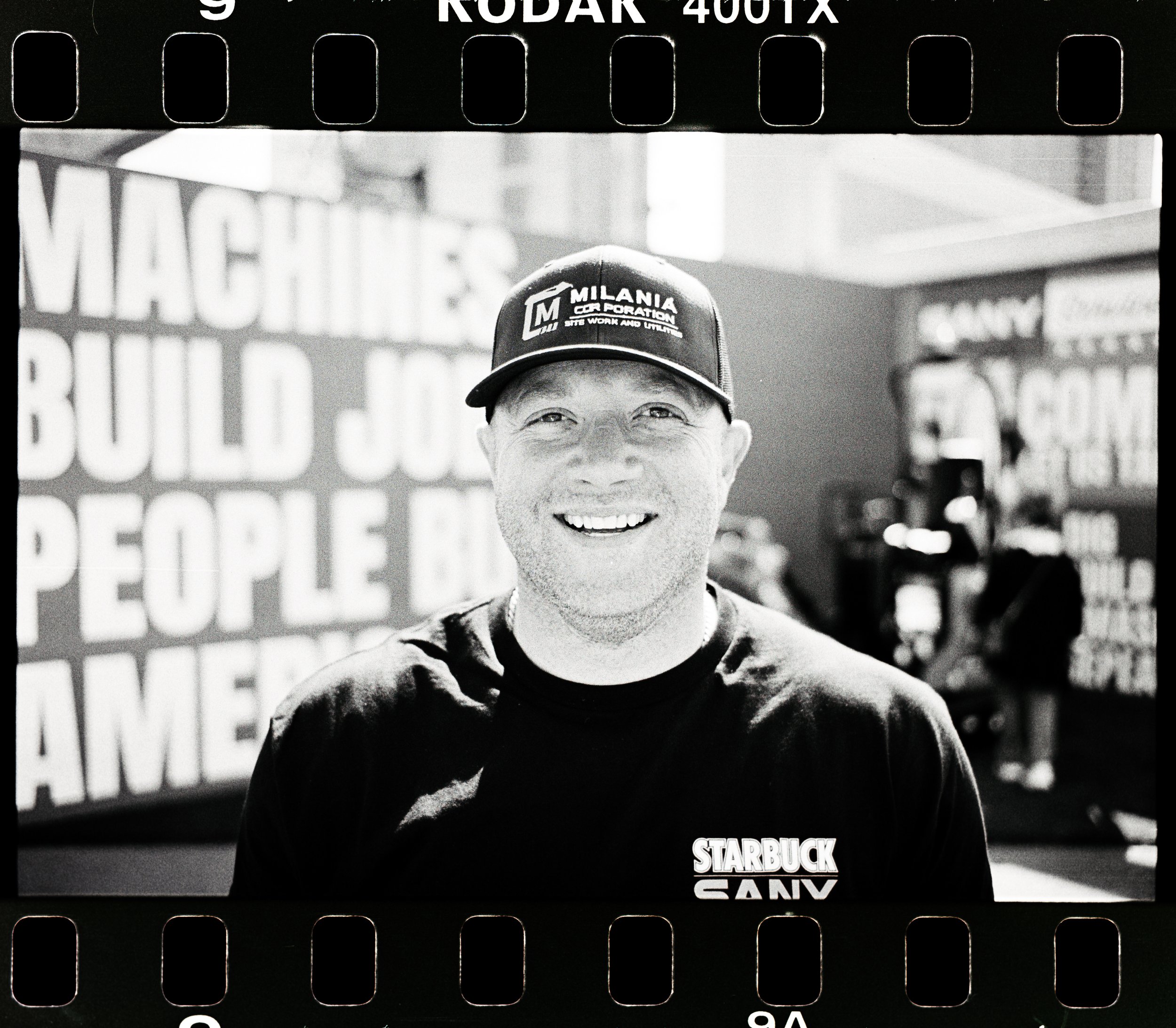
Zach Taylor is the owner of Melania Corporation and lives in New Hampshire.