019- William Christiansen
Figure It Out
A profile of Will Christiansen, Laborer, Gerber Construction
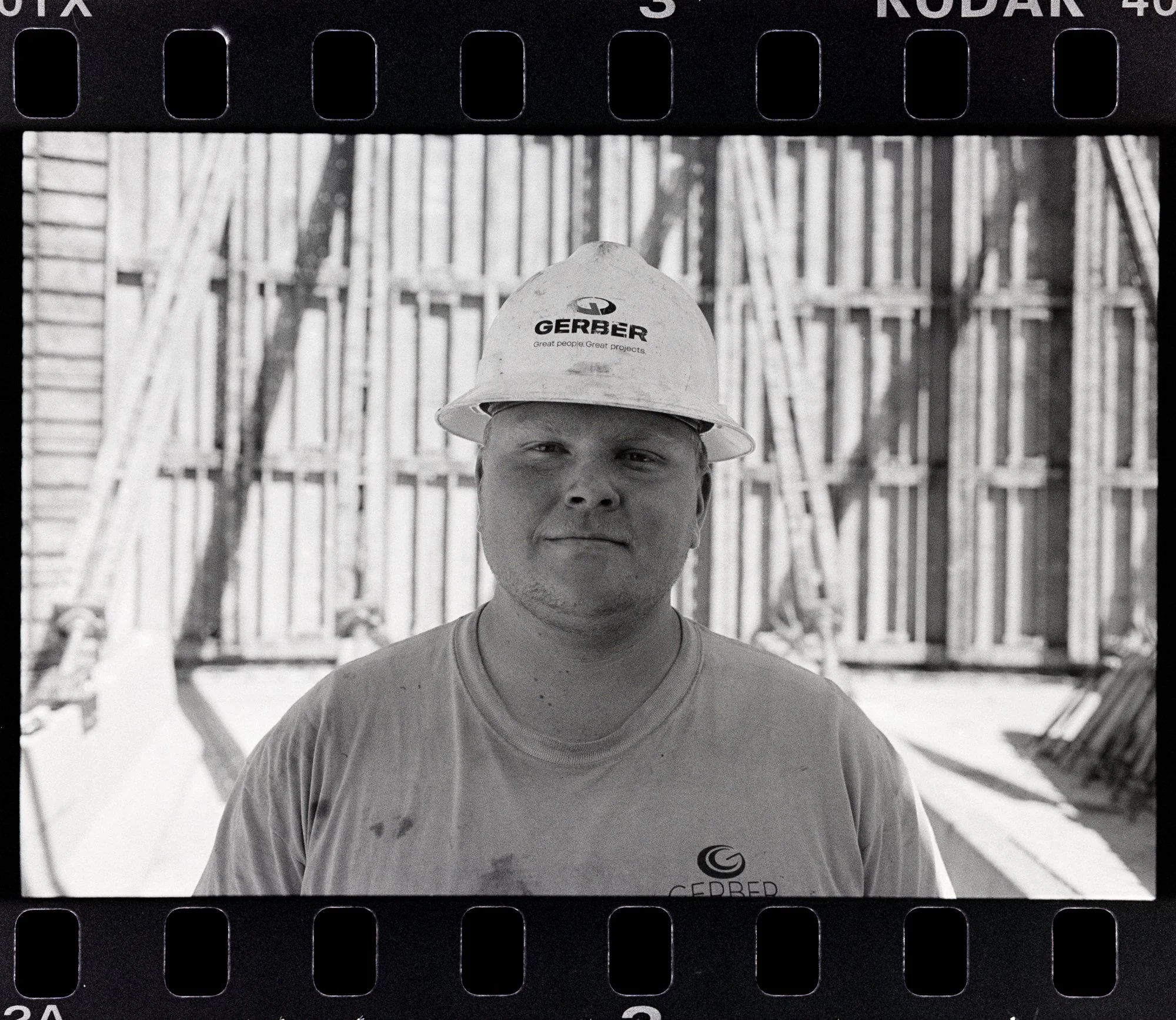
Portrait of William Christiansen. Captured on a culinary water tank construction project in Herriman, Utah, August 2026. Shot on 35mm Kodak Tri-X 400 film with Leica R6.2.
When people ask Will Christiansen what he does for work, he has an answer ready.
“We build all the stuff that you rely on every day, but you’ll never know about. And if you do know about it, something’s gone wrong.”
Will is twenty-two, a laborer at Gerber Construction, and a little over a year into the job. Most of his friends, he’s found, have never given much thought to where their water comes from or where it goes.
“A lot of my friends, they don’t know how the water gets to their house or where their sewage goes when they flush the toilet. When we were working at a sewer plant, I’d send them pictures of the sewage being processed, and a lot of them were like, ‘Oh, I never realized it had to go and get processed somewhere.’”
The job he’s on now sits at the other end of that system.
“I think it’s cool to be on both ends of that. This water tank will be for drinking water for a new housing development, and then we’ll probably also at some point have worked on the sewage system that will take all the sewage from these houses.”
Without that work, the way he sees it, things fall apart fast.
“Chaos happens. If you don’t have running water, people get upset pretty quick and then it kind of just devolves from there.”
Third Generation
School was never Will’s place. The trades made more sense to him, for reasons that run deeper than just preference.
“I didn’t really like school, but also I have dyslexia, and so that makes reading somewhat difficult. But it also gave me the ability to understand different mechanical objects and how stuff was put together a lot better.”
The work was also in the family. His grandpa worked in the trades, and so did his dad, which makes Will the third generation.
“It’s kind of a big thing to try and live up to, but it’s a ton of fun. I love working here and getting to do what I do.”
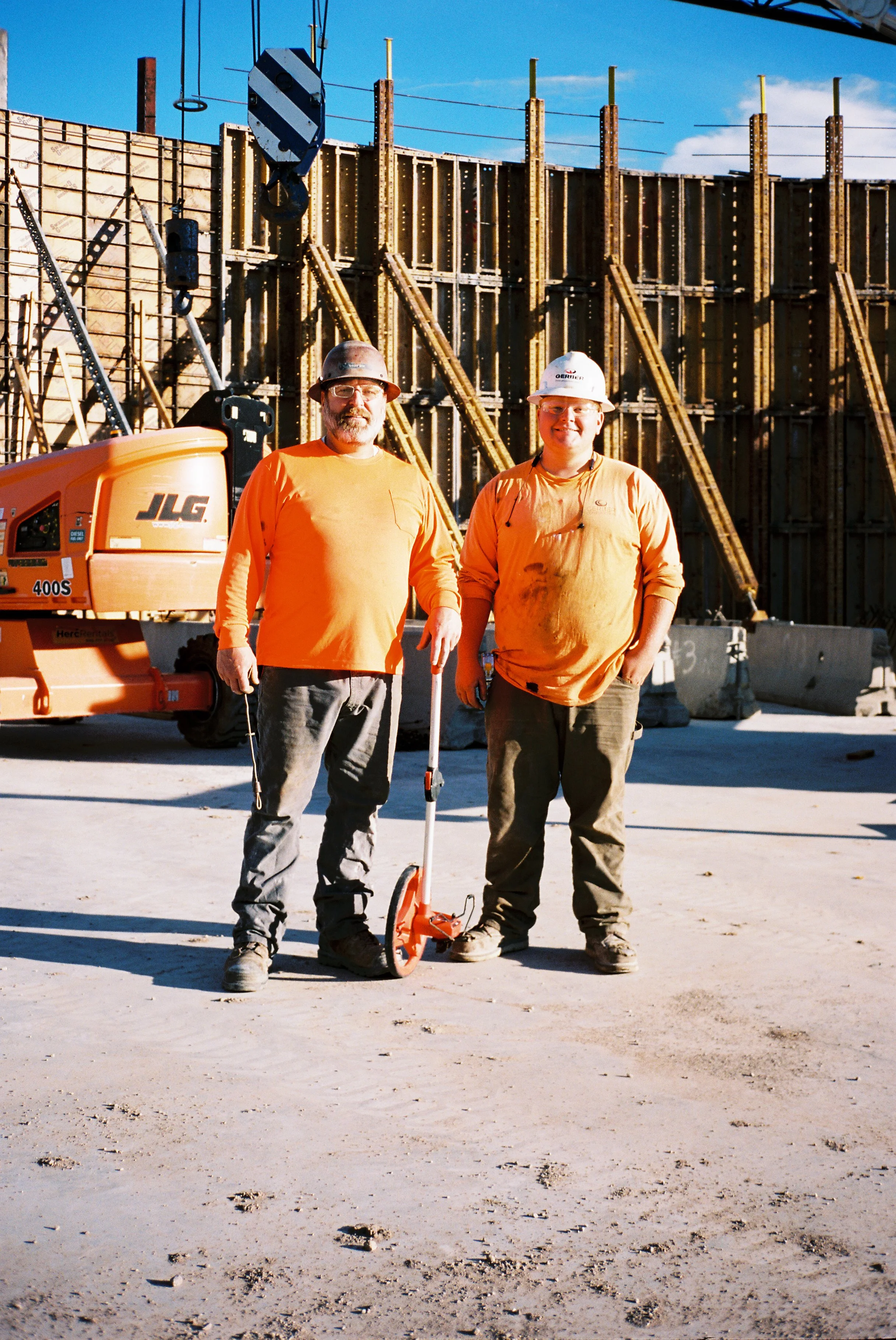
Will and his father, John Christiansen. Shot on 35mm Kodak Portra 400 film with Contax T2.
He grew up around his dad’s projects. “I grew up watching my dad do water tanks and water treatment facilities, box culverts, freeway bridges, all sorts of stuff like that.”
Seeing it from the outside was one thing. “To be honest, I didn’t really know a ton of stuff about the work he did until I started working with him.”
Not a Lego Book
What surprised him most once he was on the inside was how much of the job isn’t spelled out.
“A lot of the times we get the blueprints, but it’s not like a Lego book where you get the blueprints and then there’s pictures on how it goes together. It shows little details. Here’s how the rebar goes, figure out how to put the rebar there. Or here’s where the pipes go, figure out how to get the pipes there, get them in place, make sure they’re in there right. And then you have to build brackets to hold the pipes up.”
The prints show what needs to be built, but they don’t tell you how to actually do it.
“It’s a lot more of ‘here’s what we need the final product to look like, figure it out.’”
Figuring it out, he’s learned, is a team effort that leans on everyone’s years in the field.
“It’s definitely a lot more of drawing on different people’s experience. My dad’s worked here for his whole life and my other coworkers have worked here a lot longer. I’ve only worked here a little over a year. And so seeing my dad’s experience and him knowing how they’ve done stuff on previous jobs, and other coworkers knowing how they’ve done stuff at previous companies, kind of bringing those ideas to the table to come up with the best way to do this job.”
His favorite part of the job is exactly the part that isn’t in the drawings.
“Honestly, just being able to solve problems. On this tank, we’re using two different types of forms. We’re using Symons forms and EFCO forms, and figuring out how to get those to work together and how to make stuff work. Like, ‘Hey, we need you to do this. We don’t know how you’re going to have to do it, but we just need you to do it.’ I really like stuff like that, and just figuring out how to make it work.”
Day Two
Will came to Gerber straight from another job, and the first day was a shift in more ways than one.
“It was a little bit overwhelming. My last job, I had to be there at eight o’clock. Here I had to be here at six o’clock, so I had to get up a little bit earlier and made a bit farther of a drive.”
His first project was the Mountain Dell dam, an old structure built in the 1920s.
“We were doing some work on the intake structure on the bottom, and kind of got there and I had no idea what we were doing. I kind of just was there, told, ‘Hey, do this.’ And I tried to do it the best that I could.”
He did bring one skill with him. In high school he’d started a welding course at a trade school, finishing it the summer after graduation and into the next school year. On his second day at Gerber, that training got put to the test.
“It was also my second day working here, and so I was a little bit nervous because I hadn’t welded in almost two years. I just got back from going on an LDS mission, and then I worked at another company for a couple months. And then the second day here, they’re like, ‘Hey, you’re going to weld the pick points on this pipe.’ That’s going to be the hundred-foot-long pipe we’re dragging through the bottom of a dam, and we’re going to hook the chains onto that, so make sure they’re secure. It was a little nerve-wracking, but they worked and then nothing failed. And so a little bit of a confidence boost to be able to be like, ‘Yeah, I did that. Okay, I can figure this out.’”
The Little Things
A year in, getting handed a task without instructions doesn’t rattle him the way it did that first week.
“Now being here a year, I’m a little bit more confident in being told, ‘Hey, this is what needs to be done,’ and not necessarily how to do it, and just kind of figure it out.”
Most of what he’s learned lives in the details.
“Making sure the stuff’s square, making sure that everything’s the right measurements. Because those little things, in the moment you’re like, ‘Oh, it doesn’t really matter.’ But it adds up over time. If you have a bunch of little mistakes, it makes one big problem. And so catching all those little things early definitely helps.”
There’s a balance to it, too.
“If you want it done right, make sure to take your time, but don’t waste time on stuff. Work with a purpose.”
How much can someone actually learn in their first year on the job?
“In the grand scheme of things, a year really isn’t that long. And so if you’re really willing to just put your head down and grind it out and learn everything you can, you can progress a ton in just a year. Maybe not enough to where you could become a foreman. That usually takes a couple years, because you’ve got to prove to the company you’re working for that you’re reliable and that you’re not going to just quit and leave and go somewhere else.”
The Gulag
Will has never worked in an office, and he’s careful not to knock the satisfaction that comes with that kind of work. But he’s seen firsthand what building something does for a person, starting with his own family.
“My family, we all kind of work in the trades, and while I was on my mission, they built a house. It’s kind of funny. They nicknamed it the Gulag, which is now the name of our wifi at our house. That was because there were some days that it was snowing and raining and they’re working in the basement trying to frame it and get everything done. They didn’t want to be there, but they also didn’t want to have to pay someone to be there.”
The house gave his siblings something they carried well past the job.
“It gave my two brothers and my sister a huge confidence boost to being able to like, ‘This isn’t that big of a deal. I’ve helped build a house, so I can handle this.’”
He gets the same thing from the job site.
“With the Symons panels, sometimes you have to climb up the Symons panels and hang off of them with wall chains and tie-off points. It’s not the funnest, and it’s kind of hard, but once you’ve climbed all the way up a thirty-foot-tall wall and then climbed down, you’re like, ‘Man, I could probably figure out most things now.’”
He has a simpler version of the same idea. “If you’re a little bit apprehensive about driving a car, come out and learn how to drive a man lift, and driving a car isn’t so scary afterwards.”
Older Than Me
Off the clock, Will’s attention goes to old cars.
“I have an old Datsun 510 wagon, and then I have a Jeep Cherokee from 2000, but it’s a right-hand drive. With having to make my own parts or track down parts from other countries, it’s a lot of fun. It’s just satisfying to have a car that’s older than me and almost as old as my grandparents that’s still driving around.”
He knows how he is when something grabs him.
“I have this problem where I hyper-focus on stuff. I’ll find a topic, whether it’s old Jeeps or old cars or cameras, where I’ll try and learn as much as I can about it.”
The two cars keep him plenty busy, and each in its own way.
“I have a fifty-five-year-old car and then a twenty-six-year-old car. They kind of take up a lot of time, but I like those because one is completely mechanical. There’s no computer in it at all. The most electronics it has is for the lights. And then the Jeep, there’s a little bit more computer stuff, which is nice because when it has an issue, I can plug a code reader into it and figure that out. Usually it helps. Sometimes it just makes it more confusing.”
Cheap Tools by Hand
For Will, the best part of working with his hands is being able to point at the result.
“It’s super satisfying to be able to look at something and be like, ‘No, I made this.’ Whether it was a trailer I was helping a buddy with, where we had to completely remake part of it, and look at it and be like, ‘No, we made this ourselves. We didn’t buy it that way. We didn’t have someone else do it. We did it.’”
People notice, too. “A lot of other people think it’s cool when they’re like, ‘Oh, where’d you buy it?’ And you say, ‘No, we made it in a garage with cheap tools by hand.’”
What he learns on the job comes home with him, and he knows exactly what to call it.
“I think I’ve said it probably a hundred times, but it comes down to just being confident. If you’re confident enough to set Symons forms like, ‘Yeah, I set it right, it’s going to hold,’ when it comes down to like, ‘Oh, I need to do the brakes on my car,’ that’s a little bit more of a crucial part that if you do it wrong, it can cause issues. But if you’re confident about it, you’ll probably do it right, and you’ll probably do your research on how to do it right. And just learning that double-checking everything, even when people get upset about double-checking their work, is crucial.”
Something Steady
Will has his own theory for why fewer young people are coming into the trades.
“For a while, college was really pushed, like, ‘Oh, you need to go to college to have a good job. You need to have a four-year degree to even scrape by.’ You really don’t. You just need to have a good work ethic. And I think also a lot of people don’t quite understand that you can make a good career and a really good living off of working with your hands and doing trades.”
He knows it can be a hard sell to people his age. “A lot of kids my age, they don’t want to go and get dirty.” What he points to instead is how steady the work is.
“Here in Utah, we’re constantly building houses, so everyone’s going to need water, everyone’s going to need roads. It’s a steady, proven fact that there’s always going to be construction.”
Not every day goes to plan. Will keeps the bad ones in perspective.
“Even on days when we have a blowout with a wall, majority of the wall we poured still looks really good. And so it still was a good day.”
Winter is part of the job too.
“Sometimes it would be nice to be inside when it’s the middle of the winter and it’s snowing sideways, but even those days aren’t even that bad. And usually everyone else is also out stuck in the snow working with you.”
And then there are the people he works alongside every day.
“I love working with my coworkers. It’s a ton of fun. It’s usually pretty funny. We’ll have some really deep, serious conversations about different life topics, and then we’ll have a really dumb conversation about something else right after each other. It’s kind of funny, I guess, the flip-flop between being super serious, another person asking for serious life advice, and then going back to just making jokes and goofing around.”
What’s Next
Will doesn’t claim to know exactly where his career ends up. He does know what he’s working toward.
“I don’t know where the end is at for my career, but I would like to be a foreman one day, and so working towards that. I don’t know how long that’s going to take, but I’ll get there eventually.”
His message to the rest of the industry is the same thing he’s trying to prove on his way there.
“Just have a good work ethic and be reliable. Being reliable will take you a lot farther than you think. A lot of people think, ‘Oh, no one really notices if you show up on time every time.’ But people do notice, and it’s a big thing, especially with my dad. If you give him two weeks’ notice, say, ‘Hey, I need a couple days off,’ totally fine. It’s when you’re like, ‘Hey, tomorrow I need it off.’ If it’s an emergency, everyone understands, but if it’s just because you wanted a day off, then people are going to be a little bit annoyed.”
He boils the rest down to one attitude.
“Just a good work ethic, being reliable, and having the attitude of, ‘What’s next? What can I do better the next time?’”
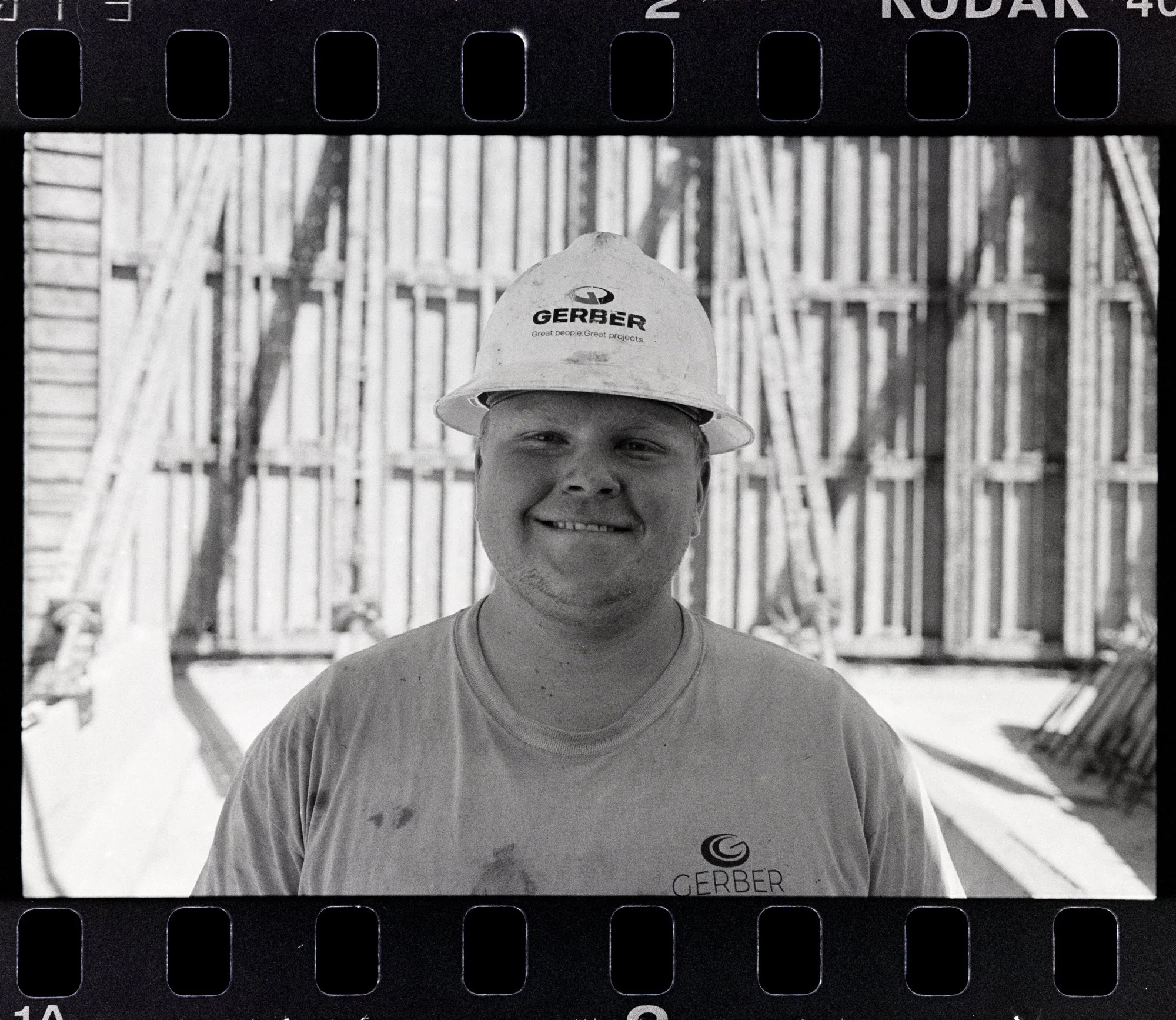
Portrait shot on 35mm Kodak Tri-X 400 film with Leica R6.2.
Will Christiansen is a laborer at Gerber Construction in Utah.