011 - Kait Burds
I Want to Be That Person
A profile of Kait Burds, heavy civil construction foreman
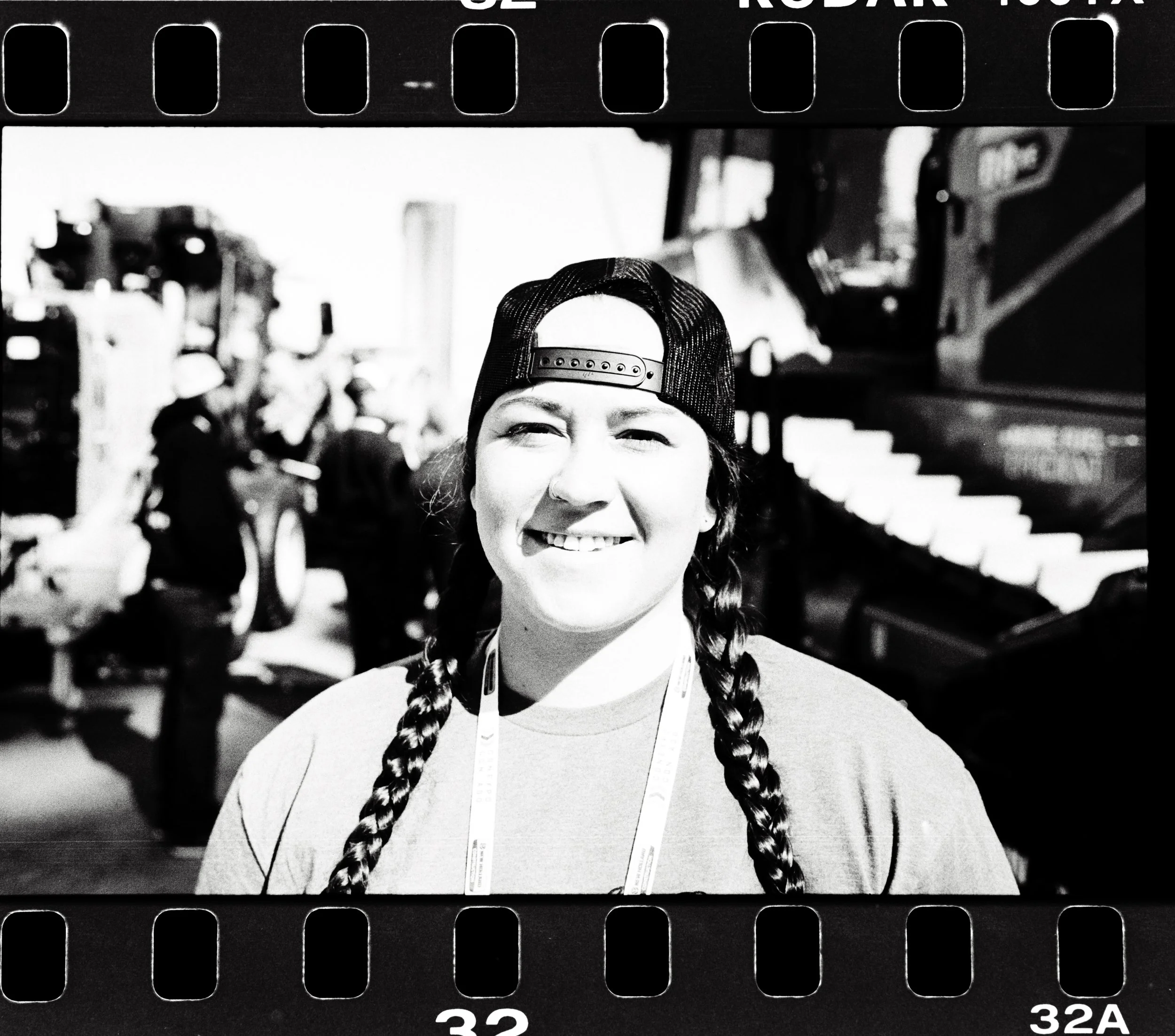
Portrait of Kait Burds in Las Vegas, Nevada at ConExpo 2026. Shot on 35mm Kodak Tri-X 400 film with Leica R6.2.
There's a kind of control most people never get to feel. Kait Burds gets it every time she climbs into a motor grader, and it's the first thing she'll tell you she loves about this work.
"I love being able to be in a machine, to have that control over something that's so mighty and beyond my reach. To be in a motor grader and to put something within less than a 10th on grade. There's something special in that for me, to have that kind of control."
Kait is from Dubuque, Iowa. She calls herself a heavy civil construction foreman who still dabbles in the Snowcat world. She's been in construction consistently for ten years, and the operating, she says, was the first love, the one that has held from season to season, winter to summer.
The Rest Is History
She didn't set out for construction. She set out for snow.
"I was a total ski bum in high school. Lived at my little ski hill, 425-foot vert."
College didn't call to her.
"I was just going to walk on a golf team somewhere and go get a business management degree or something. Super mundane, not interested in it at all."
Then someone told her about a degree in ski area management.
"I looked into that, got my degree. The rest is history. Did my internship at Beaver Creek, and that's how I got into it."
But snow only pays for half the year.
"The winter only lasts six months out of the year, if that. So I needed something to supplement my income, and that's where I got into construction. And long story short, it kind of stuck."
The Work's the Work
Ten years in, what draws her in has changed as she has.
"That's evolved as I've evolved. The first passion is definitely the operating part. But as I've progressed and I'm a foreman now, I appreciate the challenges, more self-growth challenges. Every time you get a new person in your circle, you want to get the best out of them and you want them to do a good job. And ultimately I want to do a good job. So every day I go to work, I'm challenged. It's exhausting, but it's also super rewarding."
Ask what she finds most rewarding, and she doesn't point to a finished job.
"Change, growth. I don't stay stationary for too long."
She lives in a camper, a 44-foot fifth wheel, and travels for work.
"Now I can go anywhere in the United States and I know that I've had an influence here or there on a job. I can see, 'oh, I had a hand in that.' But also just connecting with the communities that we go to, meeting the people."
Self-Respect Demands Respect
Kait went into construction wanting to be one of the guys. Over the years, she's refined what that means.
"I went into construction and my goal was to see myself as one of the guys. And I still hold the belief that on my job sites, I don't want to see gender. I see you for your value, your confidence, your skill, and we go from there."
The one place she'll grant a real difference is physical, not mechanical.
"There's some physical limitations when it comes to maybe being a laborer and gender differences, but when it comes to operating, it's a level playing field."
But blending in, she found, had its limits.
"I'm a tomboy through and through, but being one of the guys isn't always the most productive thing for me to do. I have to present myself with dignity, and ultimately that's going to encourage people to treat me with respect."
It comes down to self-respect.
"The self-respect thing ultimately demands respect from your peers. And not everybody's going to like you. And honestly, that's something I just have to deal with. And that's okay."
I Had to Make a Change
Mental health is the part of a job that rarely makes it into the conversation. The grade, the machines, the hours, all of that gets talked about. What the work does to a person, and what that then does to their life off the clock, usually stays unspoken. Kait didn't leave it there. Asked about the last year, she went straight to it.
"I just felt like I had a really tough year professionally, which affects personal life. The irony of it is I was the closest to home that I've ever been. I was operating. I was still doing the work."
It reached a point she was willing to name out loud.
"It just got to a point where I personally felt like the thought of me kind of hurting myself was a little more comfortable than just continuing on. And when I got to that point, I just realized I had to make a change."
So she did.
"Nobody else is going to change for me. Nobody's going to change the job, the manager, any of that. I didn't like my circumstances, so I decided to change them. And I'm glad that I caught up with that. I left my job. And I'm not a quitter. I think it was kind of a long time coming, and just part of that growth for me."
The change didn't resolve cleanly. The next company wasn't the right fit either, and she learned what it costs to keep starting over.
"Going to a new company, everything that you go through and establish yourself at the previous company, you restart. And I'm too old for that. I'm done with petty abuse."
What she landed on was a boundary. Then she flipped the question of who's lucky to have whom.
"My mental health isn't going to get better if I don't set boundaries for people not to step on me. If a company or anybody isn't promoting that healthy workplace, then you don't get the privilege of working with me. That's where maybe in a past life I would've said I don't get the privilege of working with them. Now, to have me on your crew, and I'm going to give you 100% of what I have, that's a privilege for you."
She's with a small company now, and hopeful about it.
"The outlook is promising. We get to build our crew and go do the work we all know how to do, with people who are professionals and take their jobs seriously."
Down the road, her goal is to go out on her own.
She's honest that the years have marked her.
"I've probably gotten a little bit jaded. I've got trust issues. But in a good sense, I've matured a lot too. I'm grateful for the adversity I've faced, good and bad. I don't know if I would've gotten to this point without all of that. I sometimes don't feel as bubbly or colorful as I used to be. So that's the relationship with myself that I'm working on, constantly. This isn't the final chapter."
The Backbone
Ask how she feels about being a blue collar person and there's no hesitation.
"I'm proud of it. I appreciate people who work with their hands, people who use their mind and can execute doing something else. Blue collar is really super encompassing. There's so many roles outside of just the boots on the ground. But then there's also the blue collar spouses, partners. They really help keep those people grounded. We know they're the backbone of America. We can't not have them."
I Want to Be That Person
Last year, Kait competed in Cat's Women in Construction Skills Competition. She won. But the trophy isn't the part that stuck.
"My focus wasn't to win. My focus was to go network, meet people, have a great time. And it was super validating that what I do is important to maybe four people, but those four people really care. And that's growing."
She never set out to be an influencer. Lately, though, she thinks harder about what she puts into the world.
"Instead of snapping a silly photo, I'm thinking, who is this going to affect positively or negatively? I want the people who care to know it's coming from a good place in my heart. I want to be that relatable face or vessel."
She has a specific person in mind. A girl, seven or eight years old, watching from the side of the road the way Kait once did.
"I remember a long time ago, driving on the highway, and there were excavators. You can see the guys on the ground and the people in the equipment. And I remember saying, 'I want to be that person.' And somebody said, 'Oh, you're never going to do that.'"
She put it out of her mind. Didn't think about it again for a long time.
"And it's just funny how full circle and random everything is."
Now she's the one in the equipment that a kid on the shoulder of the highway might be watching. What she wants to do with that is simple.
"Try to be somebody that somebody looks up to. I think that's a huge privilege. And I try to treat it with the most respect."
As a kid, she was told she'd never be the person running the machine. Today she's a female foreman in a male dominated industry, and she's still climbing.
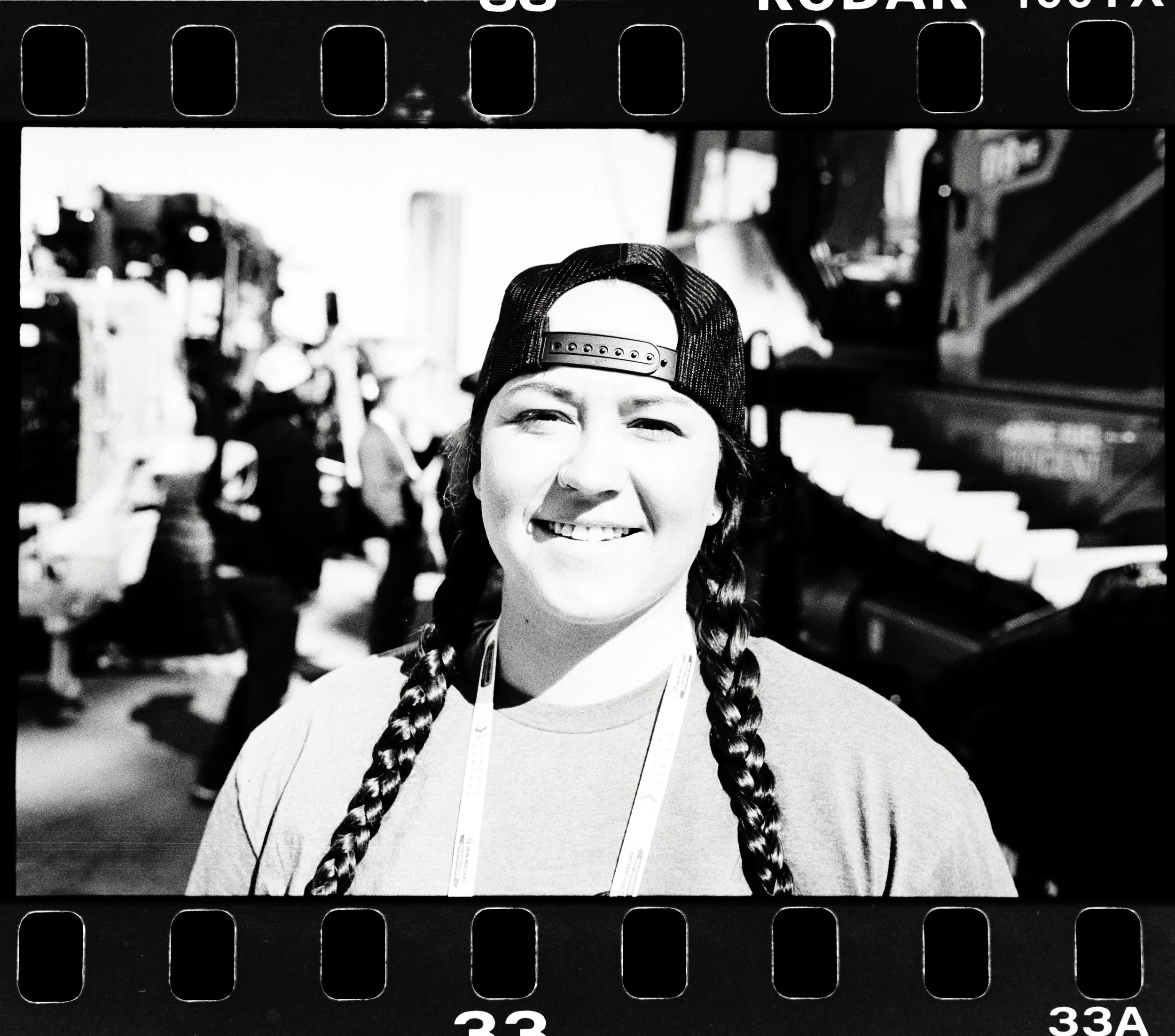
Kait Burds is a heavy civil construction foreman from Dubuque, Iowa.