020- Kheldon Stapley
Not Broken, Just in Need of Some Work
A profile of Kheldon Stapley, field service mechanic, Wheeler Machinery
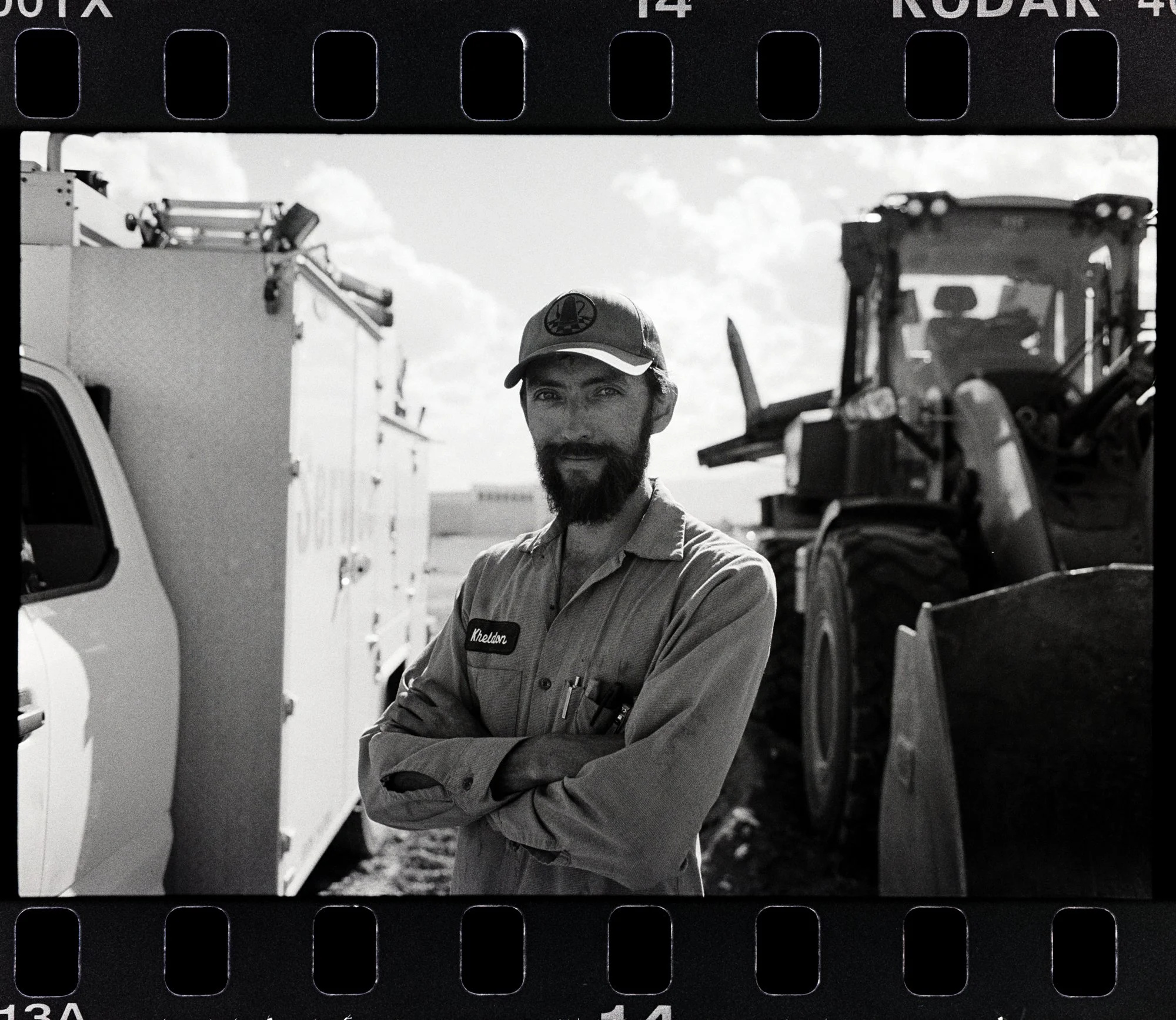
Portrait of Kheldon Stapley. Captured while on a field service call in Tooele, Utah, August 2026. Shot on 35mm Kodak Tri-X 400 film with Leica R6.2.
“Leaving high school, I’ll tell you what, I had no idea what I wanted to do. I actually wanted to be a chef because it was the only thing I could think of. I like to cook, I guess. I didn’t know any other career paths. I didn’t know any trades or anything.”
That was Kheldon Stapley as a kid in Tooele, Utah. Today he’s a field service mechanic for Wheeler Machinery, a Caterpillar dealer. When a Cat machine goes down, he’s the one who drives out to wherever it stopped and gets it running again.
Small Town, No Plan
He describes his childhood without much decoration.
“My story is much like most other kids, small town. It’s pretty much a generic little white boy growing up in rural Utah story. Went to school, went home, caused trouble, went to school, went home, caused trouble.”
Before the trades, there was fast food.
“I worked at McDonald’s flipping burgers in the back, getting yelled at. I didn’t know what I was doing. I didn’t care to know what I was doing.”
The clue was there, even then.
“I knew that I liked working with my hands with things. I like building things. I used to build worlds with Legos and just tinker and mess around with stuff, build things in the backyard and just get wild and create.”
Everyone around him pointed somewhere else.
“I knew I had to go to college, I guess, is what everybody said. Go to college after high school or else you’ll be a bum, you’ll be stuck in this hometown of Tooele forever.”
He looked at what college would cost and didn’t want to put that burden on his parents.
“We didn’t have a whole lot growing up anyway and decided, well, I need more direction in life right now. So that’s what led into the military.”
The Flight Line
Kheldon enlisted in the United States Marine Corps and became a ground support equipment mechanic.
“Anything on the flight line that’s not the bird, we took care of, we maintained, we inventoried and we supported the flight line. In my unit, we supported, I think it was nine active squadrons at times. The top we had was nine and that was really eye opening.”
He moved up fast, just not in the direction he wanted.
“Very rapidly in my enlistment early on, I was distinguishing myself in a way that was, ‘Well, you know how to handle books, you know how to maintain a work center, you know how to lead a little bit, so we’re going to kind of give you more of these responsibilities.’ And before I knew it, I was a work center supervisor before I felt confident on the tools essentially.”
His wife enlisted around the same time he did, on a six year contract to his four. With his four years winding down, the two of them talked through their plans for getting out and finding work.
“I could either re-enlist for another four and she could get out and find a job, or I could get out first, find a job, that way we weren’t getting out around the same time being jobless.”
His re-up package was approved. He canceled it and served one enlistment. Getting out meant figuring out what came next.
“I was looking at it and thinking, where was I most happy at? And I realized I was most happy when I was fixing things.”
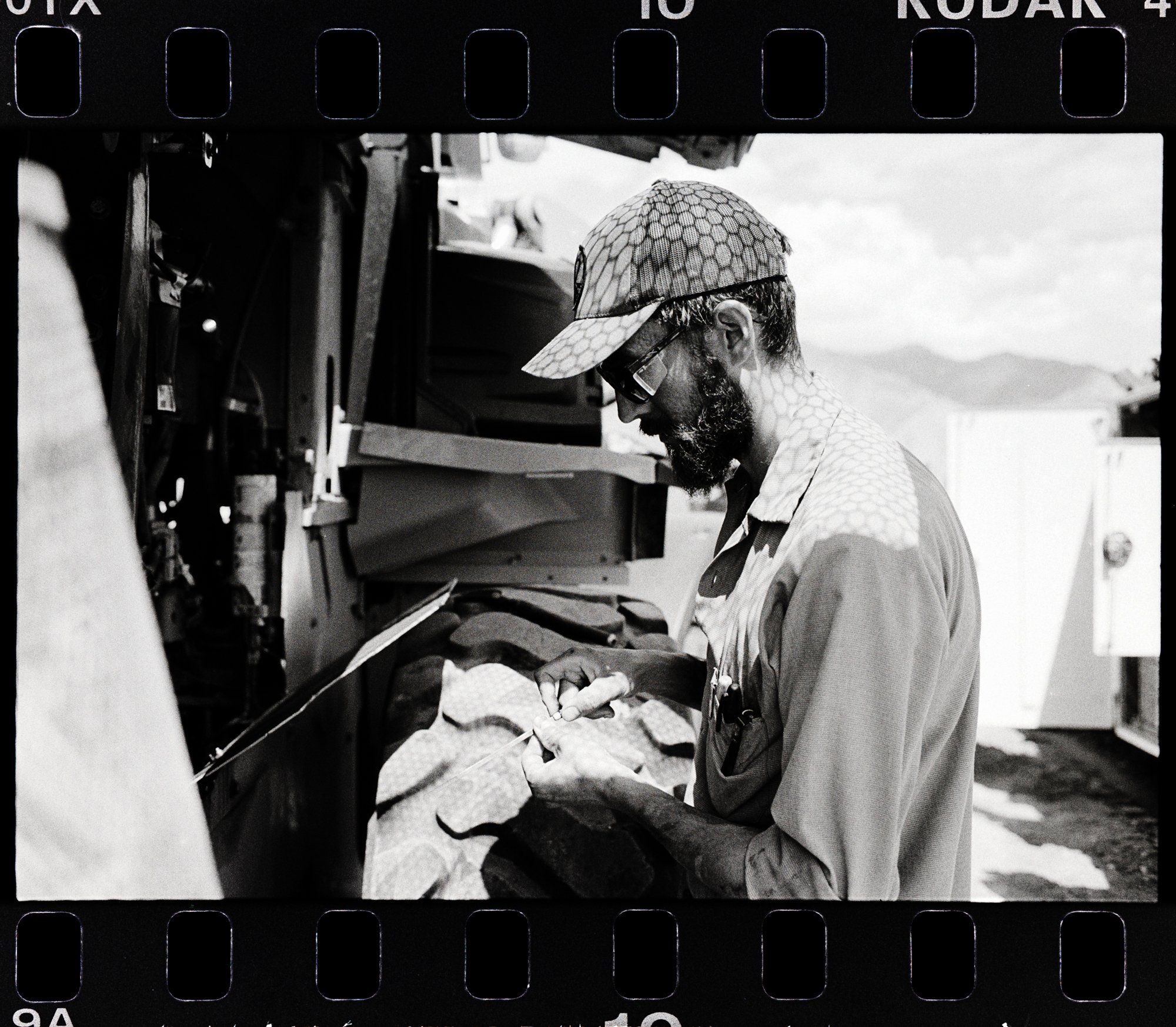
Photograph shot on 35mm Kodak Tri-X 400 film with Leica R6.2.
WyoTech
The base hosted career fairs for Marines on their way out, and the mechanic schools came recruiting.
“I ended up settling on WyoTech because the recruiter at the time really explained the importance of the schooling. Everywhere else kept telling me about how my GI bill benefits would cover this and that. But the WyoTech coordinator said, ‘This is how we set our graduates up. This is how we get you to where you can step into the trades and not fall on your face.’”
He spent a year in Laramie, Wyoming. WyoTech held its students to a strict standard of its own, and after the Marines, it felt familiar.
“You got to remember, in the Marines, clean shaven every day. You got to have your uniforms on squared away every day. You got to be militarily ready to a T, not unlike going to school. [At school, you] could not have a beard. You could have a mustache, corners trimmed. You had to wear your school uniform, buttoned up, tight and neat, have your badge displayed. It was very much so a continuation for me.”
The heart of the program for him was advanced diesel. Trucks came in from auction yards, and each team was responsible for one, bumper to bumper.
“Ours came in on a hook. It had a seized engine, spun number three main. And so we had to push it into the shop, get it set up on these stands, tear it all the way apart, get the engine out, put it all back together. Whatever it needed, you fixed.”
It paid off the first day he went to work.
“When I showed up my first day at a local Volvo dealer and rolled my toolbox in, they’re like, ‘Here’s the keys, go pull one of those in. It’s got rough running.’ I said, ‘Cool, let’s go.’ Jumped in the truck, pulled it in. [It] needs injector cups. We got air in the fuel.”
Looking back on that year, he’s clear about what it gave him.
“The school itself, the value of it, I wouldn’t be where I am today if I hadn’t gone to school.”
Where the Machines Go
From there, Kheldon spent six years in a Caterpillar dealer’s electric power generation shop.
“Crushers, generator sets, over the road trucks, the Cat truck, snow groomers, all sorts of things. Anything that had a Cat power plant in it or was a Caterpillar generator that was not earth moving was what we dealt with.”
He didn’t stay on apprentice work for long.
“Within a short amount of time, I was already distinguishing myself. I was getting to the point where it was, okay, well, go rebuild that engine, go tear this one down, go troubleshoot this water truck. There was more advanced things than what would traditionally be an apprentice level task.”
Now in his fourth year in a field truck, his shop is wherever a machine quits.
“In my particular trade, we go where the machines go. I’ve been to the very top of ski resorts because there’s been machines dead at the very top of ski resorts. I’ve taken this truck in places that I don’t even know if I dare take my pickup truck, but I got to get to the machine. I make it there and make it out.”
Being the one they call comes with its own reward.
“There is absolutely nothing more satisfying than being able to find a problem, fix the problem, and then see that machine go right back to work. I have been on machines before where it’s down, it’s in the middle of a job site, it’s in the middle of the road, traffic can barely move around it. And you roll up, you find out what’s wrong with it, you get it running again and it’s moved out of the way and you can just feel almost like a palpable relief of everybody around you.”
There’s no waiting around to find out whether he got it right.
“You get a chance to see the impact of your work immediately. It either works or it doesn’t. You either fix it or it’s still not fixed and you got to keep trying. It is there. It is tangible.”
Some customers can’t afford to wait at all.
“Out at one of the landfills out in the middle of the desert, do you know what never, ever, ever stops? Trash. Trash doesn’t stop. It doesn’t take a day off. Machine goes down, they can’t wait. They need that fixed ASAP because the trash does not wait. The machine goes down, we got to get out there. We got to get it fixed. And we do.”
More Retirements Than Anniversaries
Kheldon sees the shortage of tradespeople from the inside.
“I could leave this job I’m at right now and find five other jobs waiting for me. We need people out here and we’ve been needing people. And honestly, I’ve seen more retirements than I’ve seen anniversary dates. There’s people leaving, taking vast wealth of knowledge with them and it’s not getting backfilled anytime soon.”
Some of the people walking out the door knew the machines cold.
“I’ve watched a couple people retire that they’re the kinds of people that if you had a single question about hydraulics, you could call them and they’d be like, ‘Yeah, check this, this, this. Should be this, should be that. And if it’s not this, then it’s that.’ And they’re gone.”
They also came up in a harder era, and it showed on them.
“They’re also the same guys though that came up in the era where they didn’t give a shit about you, and watching them walk hurt me, just watching them walk. They came up in a time where you jump into a field truck and they own you. That was the expectation. You take the truck, that’s your life.”
His own experience has been different.
“Nowadays, I have childcare limitations. I can’t start until a certain time, but I can still get my hours in. So they said, ‘That’s fine. As long as you can make the minimum requirement, that’s fine.’”
The machines have changed as much as the job has. Diagnosing a modern Cat machine means talking to its computer through a program on a laptop, and until recently, that meant plugging the laptop into the machine.
“Last year, Caterpillar came out with a way to run an emulator, so you can run that program on a remotely connected machine in the field without ever having to plug anything in. I know of machines right now, I could open my laptop and connect to and see live data as they’re working wherever they are without ever having to see the machine.”
That means a lot of his diagnosis can happen before he ever reaches the job site.
“I can literally open up a machine, pull a serial number, find out where it’s at, look at its fault codes, get a product status report, look and see what I need to do before I even leave the house in the morning. And then I can say, ‘I need these parts. It’s got this code. It could possibly be this.’”
The mechanics who came before him had none of that.
“There was guys who came up in the era where they didn’t have anything except your mechanical know-how. You had to know if an engine was running rough, why it was running rough, because there was no computer on it. It’s a mechanical governor. It’s a mechanical air fuel ratio. It’s a mechanical everything. Those guys had to know how to troubleshoot that with just basic mechanical knowledge, just being a good mechanic.”
Those older machines are still out there working, so he needs both skill sets.
“I still come up on those machines where you have to know that old school stuff, but at the same time, you have to be able to adapt yourself to being able to look at a trouble code that’s super generic and vague and think, ‘I think I know where to start with this.’”
That’s why he thinks right now is the moment for someone new to get in, while the old guys are still around to teach.
“You have old school stuff out there still kicking ass and people run every single day. And the old school guys who are still there, for the most part, are pretty amenable to wanting to pass the knowledge on. They’re looking for somebody who wants to learn. So if you have the opportunity to be able to jump in right now, get that old school knowledge, still work on the old school stuff while applying everything to the new school stuff that you know, literally you are going to be unstoppable. You’re going to be unfireable.”
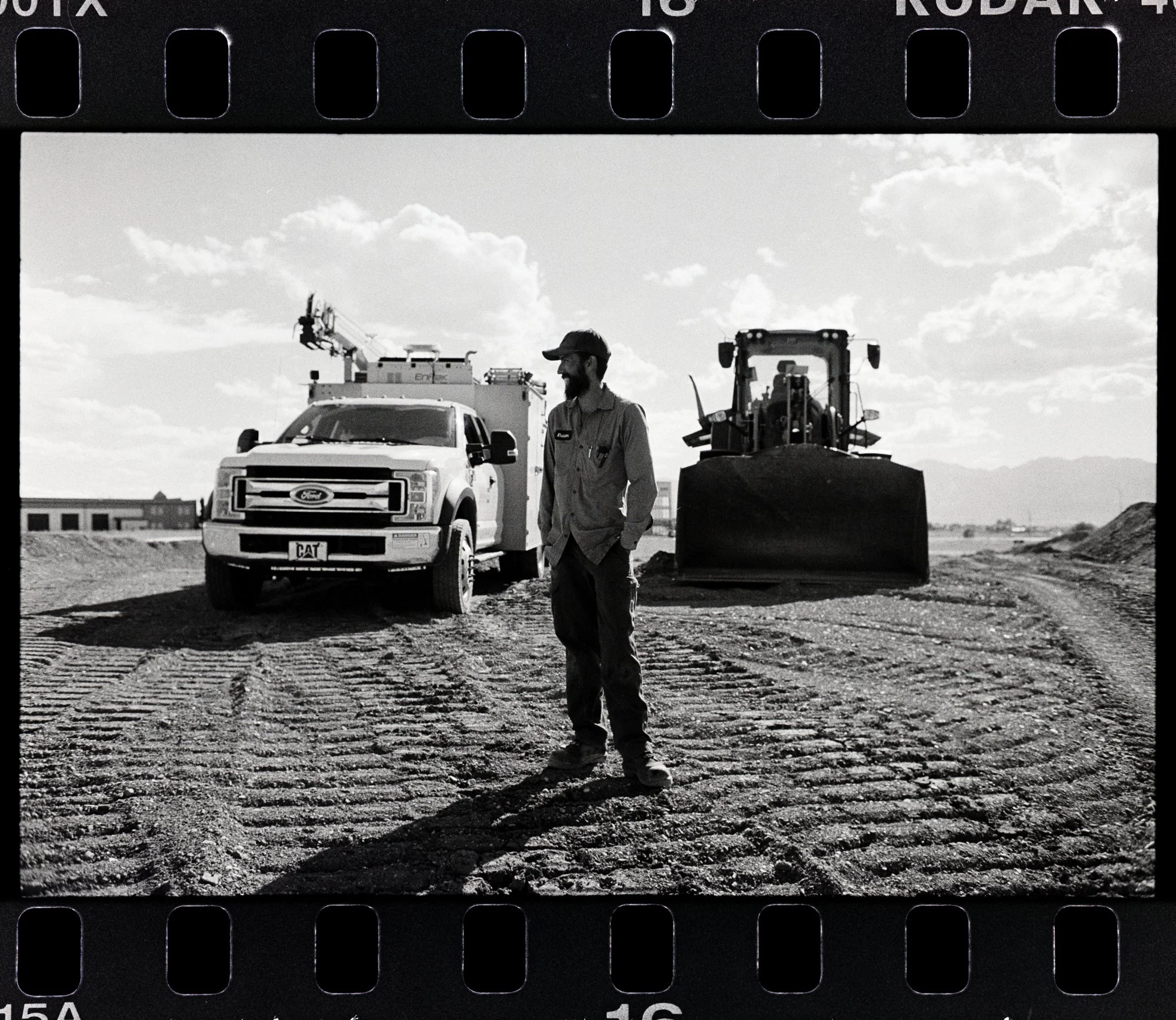
Portrait shot on 35mm Kodak Tri-X 400 film with Leica R6.2.
The Life It Built
The career started paying off outside of work almost right away.
“When I graduated, it helped me find an apartment right off the bat. I had a month under my belt and they signed a lease for me. When I bought my house, I’d only been working for a year and they looked at that and said, ‘That’s a good career. We’ll go ahead and finance you for this.’”
Before kids, it bought him time on a dirt bike.
“I like to do trail riding. I like to do enduro riding. Tuesday night, I’d load the bike up in the back of the truck, take it to work, and I’d take two hours PTO on the back half of the day. I’d go hit the trails for a couple hours after work and then come home and enjoy a little bit of time hanging out with the wife, and then we’d go out to dinner or something.”
These days his time off belongs to his family.
“I had kids a little bit late, so I got a five and a three year old and that is life. We want a membership to the aquarium because we go there a lot. I didn’t have a second thought before I was like, ‘Yeah, let’s get a membership. Let’s go.’ It gives me the ability to provide a life for my kids that I never had.”
Growing up, there wasn’t room for things like that.
“I didn’t grow up well off by any means. We weren’t on food stamps necessarily and we weren’t destitute, but we didn’t have anything extra. We literally had the bare necessities and that was it.”
Now his career gives his family that room, and he knows exactly where it comes from.
“I wouldn’t be able to do that [for my family] without my job, without my career, without the trades, without turning wrenches.”
Just Another Challenge
Fixing things for a living has changed the way he thinks.
“It’s taught me to view problems not as ‘woe unto me, it’s insurmountable, why is this my problem?’ It’s helped me to grow from those kinds of thought processes and those kinds of feelings into something where it’s an opportunity to learn, to grow, to beat the problem, to overcome it. Because I know if I come up against a problem, that is just another challenge. And I know I’ve faced so many more challenges before this and I’ve won and I’ve come out on top. I’ve fixed the machine.”
It goes beyond merely his job and the machines he fixes.
“It’s helped me see the world in a broader perspective. It’s helped me see things as not necessarily broken, just in need of some work. And that can go from everything from your thermostat on the wall to a relationship with a friend that’s fallen out.”
He recognizes something from the Marines in it.
“There’s something to be said about the warrior mindset. Having been in the Marines where it is hammered home, the warrior mindset is part of our culture and you bond with people in ways you didn’t ever expect you would bond with anybody. Well, it’s almost similar in the same fashion in the trades because you’re sharing the same blood, sweat, and tears and you’re sharing the same struggles and battles. And at the end of the day, you’re not doing it alone. So it really has changed my methodology of thinking and my viewpoints and mindset, and it’s helped me grow into a better person.”
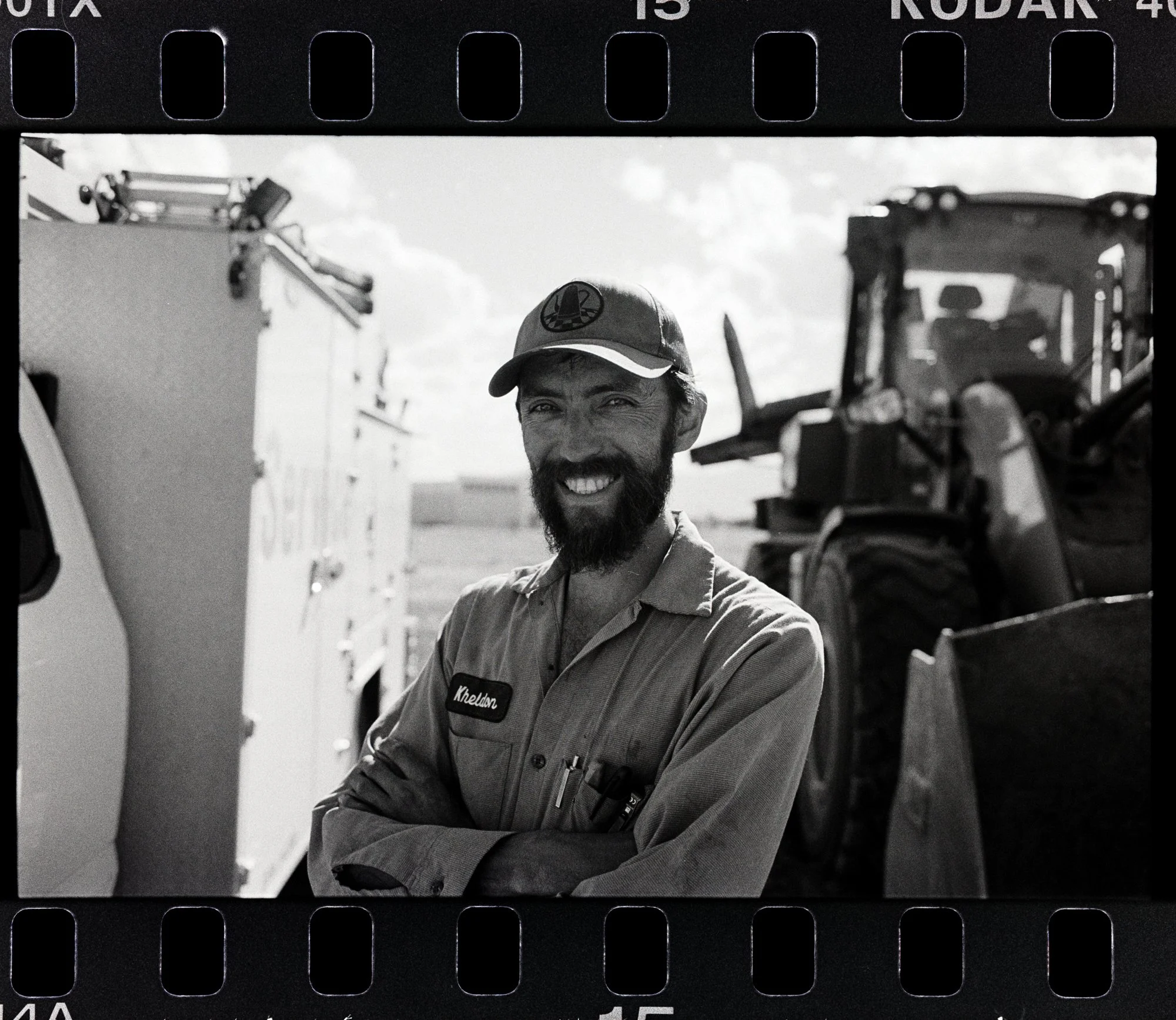
Portrait shot on 35mm Kodak Tri-X 400 film with Leica R6.2.
Kheldon Stapley is a field service mechanic at Wheeler Machinery. He grew up in Tooele, Utah.