A Labor of Love
A profile of Jessie Demler, Foreman, Shane Demler Masonry
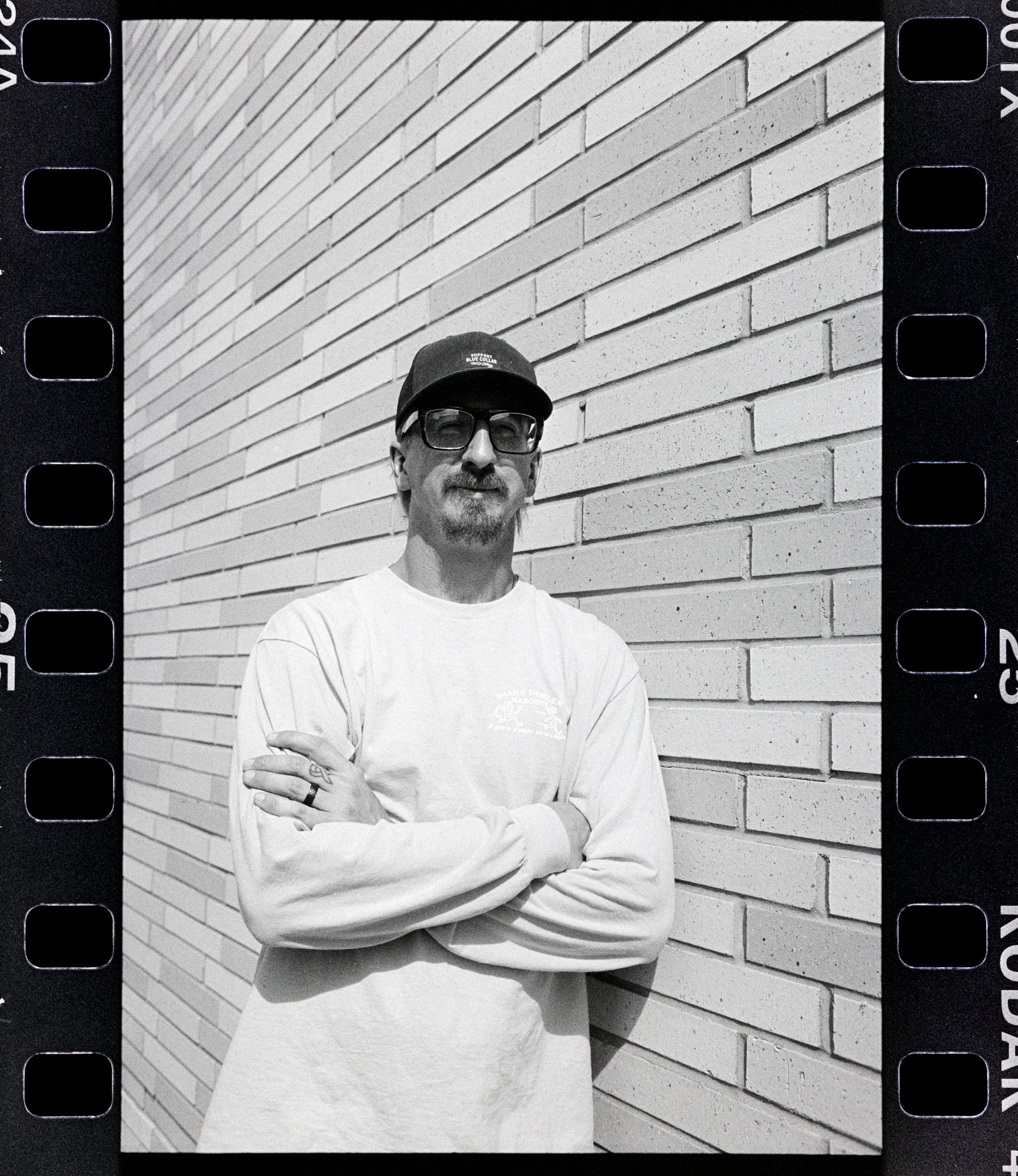
Portrait of Jessie Demler. Captured at the Utah State University Institute of Religion building in Logan, Utah, August 2026. Shot on 35mm Kodak Tri-X 400 film with Leica R6.2.
“No one travels halfway around the world to see a spreadsheet you made. But they will go see a cathedral.”
Jessie Demler is a fourth-generation mason and a foreman at Shane Demler Masonry, his family’s commercial masonry company in Cache County, Utah. This fall, his dad hit 30 years in business.
“Most people call me Slim,” he says. Online, he goes by @slimbrick.
The Sand Pile
Jessie’s dad is a contractor, and Jessie spent his childhood on the job site.
“I grew up in a world of seeing people create a successful life in the trades. I didn’t go to daycare. I never got babysat. They just took me to site. I got to play in the sand pile. As I got older, I went to work and learned from those guys.”
Away from the job site, he heard a different message. It was the same one most of his generation grew up with.
“Especially my generation, it was pushed so hard, like, ‘Go to college, get a good job.’ I think the collegiate industry just did a million times better marketing than the construction industry did. For so long, so many people heard that, like, ‘The trades are a backup plan, or they’re for people that can’t figure out school,’ which was never true.”
What he saw on the job site told him something else.
“It’s like, ‘If you don’t go to school, you won’t have a good life.’ But then I am on site and I’ve seen all these people, and everybody I know is like, ‘Oh, you have the cool truck. You have the boat.’ And that’s all created by a career in construction rather than the alternative.”
To Jessie, calling the trades a backup plan leaves out what the work actually asks of people, and what it gives back.
“You get to build things that last the test of time. You leave your mark on where you’re at and create places for people to use for the next hundred or hundreds of years. You have people that get into this that really, really, really love it, and they get to still flex their brain. We do a lot of math. It takes a lot of skill to do a lot of the things that we do out on the job site.”
Life-Size Legos
Jessie has a simple way of describing what he does for a living.
“The funny thing I always like to say is, ‘Bro, we get to play with Tonka trucks and Legos. They’re just life size now.’ That’s what we love to do as kids. So if you boil it down to that, that’s what we get to do every day.”
The work is hard and physical. It’s also a lot of fun.
“There’s still this camaraderie and community. We have fun. We joke around. That’s all day.”
The rest, he says, comes down to how you look at it.
“All the stuff that I liked as a kid, playing in the sandbox, I get to do that as a career. And so I think it’s just a perspective flip of like, ‘Oh, I’ve got to go do this backbreaking thing, or I got to do manual labor for construction,’ when in reality it’s, ‘No, I’m just doing what I was doing as a kid, but on a grander scale.’”
Good for the Soul
The best part comes at the end of a job.
“When it’s done, you get to step back and look and go, ‘Okay, we did that, and someone’s going to be able to utilize that or enjoy that or feel safe in that.’ It’s a career where you get to see the progress and the impact you can have on a community or a person with their home. It’s very gratifying.”
It means the most when the people it was built for see it.
“There’s nothing better than producing something with your craft, with your hands, and then getting done with it. Whether it’s the homeowner or the contractor or the owner of the building, having them come up and be mind blown by what you built for them and how you brought their vision to life, or you created this thing that they’re going to see every day and it’s beautiful to them. To see at the end product how much they appreciate it and what it’s going to create for their life, to know that you had a huge role in creating that for them, it’s just incredible. It does a lot for your soul.”
Laid by Hand
A lot of people worry that AI and robots are coming for their jobs. Jessie doesn’t see that happening to work done by hand, at least not for a long while.
“I’m not saying [the technology] can’t get better. I’m not ignorant to the fact that technology is incredible. But just logistics wise, setting all that stuff up on a job site, all of it running. We have dirt crews where the trucks are autonomous. But when it comes to doing things that are installed by hand, whether it’s masonry, it’s electrical, it’s plumbing, all that sort of stuff, logistically, maybe not impossible, but it’s exponentially harder to get that done without a human.”
Even if a robot could lay brick someday, he says a mason would still have something to offer that a machine can’t.
“Say you were worried that, oh, they came out with the robot that can do my job. You could always market yourself like, well, there’s a personal aspect to it. I’m at your house, you can ask me questions. We can talk about it. I can change things. And then it’s also laid by hand. It’s a labor of love rather than just a product.”
Half a Million Brick
Drive through the Utah State University campus with Jessie and he can point out his family’s work.
“My dad did all these student housing buildings. There’s seven or eight of them right here. They did that when I was a teenager.”
Across from them is the Institute of Religion building, which he calls the coolest project the crew has done in the last five years.
“We finished a year and a half, two years ago, and this thing’s incredible. There’s half a million brick, and each one of those pieces of precast we set weighs at least 5,000 pounds. That was all done with a crane, and then we laid the brick around it.”
What makes it gratifying for him is the people who will walk through its doors.
“It’s incredibly gratifying. This is an institute of religion building, and where we’re from here in Utah, religion’s really important to these people. They revere this building. They’re coming in to spend time on something that means a lot to them. So the fact that we were able to build something that’s beautiful for them to come in and have that experience in their life, that’s incredible to have in your back pocket, like, ‘Oh, we positively affected that many lives.’ They can come and sit in this grass area and admire it, or they can feel the feelings that they’re going to get from their experience while being in this building. That’s definitely something to hang your hat on.”
The Gap
The entire construction industry is running short of skilled workers. Jessie lays out the problem in numbers.
“You’ve got 500,000 to 700,000 people that are going to retire in the next five to ten years, and for every three of them that are retiring, we’ll get one back into the labor force. So there’s a big gap there that we haven’t quite figured out how to fill.”
He sees the pressure landing on everyone.
“We have a ton of stuff to do and not as many hands to do it. So it ends up putting more pressure on the guys that are doing it. It puts more pressure on the contractors that need to hit schedules. It puts more pressure on the industry as a whole to get everything done, but also to be able to capture the knowledge of those guys that are going to retire and get it into someone else’s hands or minds so they can keep that going too.”
Jessie traces the gap back to the go-to-college message he grew up with. He thinks the fix starts with the industry telling its own story better.
“I think the construction industry needs to do a good job of presenting itself as to what it actually is, and the fact that you can build a career that’s satisfying and fulfilling. Maybe that’s where social media comes into play, or media pieces, of getting that pendulum to swing back this way of like, ‘No, look, this is the life I built. You can do it too, and this is why it’s satisfying to me. If that resonates with you, come check it out.’”
He says the younger workers coming up are looking for exactly that.
“The kids want something to be passionate about. The money’s cool, right? That’s how the world runs. We got to do that song and dance. But a lot of these kids are trying to find something that makes them feel fulfilled. That’s where the hunger comes from now, more so than money. ‘I want to do something that I go in there every day and feel good about.’”
Not Like It Used to Be
The job site has changed a lot since Jessie was a teenager working summers.
“The dudes that came into the trade were the old school. It’s like watching someone try to break a horse. I was like, ‘I don’t know why you need to beat me down into this.’ Those guys would just test you to see if you could stand it, and once you could, they were like, ‘Cool, you’re cool. Come over here with us.’ Versus now, we tease each other, but it’s friends. It’s a friendlier atmosphere than it was back then. You’ve got a lot of people that want to see someone succeed.”
Safety has come just as far.
“My dad tells me stories of back in the day, the hoddies [hod carriers] would be up on scaffold on one plank. And now we have hydraulic scaffold that climbs itself. We got rails. Everybody wears a harness when you’re up at height. People actually give a shit about if you’re wearing your safety glasses, your ear protection, or making sure that there’s water on the saw for dust mitigation. I think more people care now.”
The old habit of proving how tough you are doesn’t impress him.
“I don’t care what you could carry at work if by the time you’re 60 you can’t stand up. That’s how the industry’s acting more and more as my generation and the younger generation comes into it. They’re not so much caring about bringing their ego onto the job site. It’s, ‘Let’s get some things done and be able to take care of ourselves and go home and enjoy our life after the fact as well.’”
That change is what makes room for someone brand new.
“Our company’s not afraid to start someone who’s green. And you’ve got the people in place on site that are willing to show that person the ropes rather than tell them they’re dumb. So it’s a much better environment than it used to be as far as bringing someone in that’s totally unfamiliar but curious.”
Seeing It Click
As foreman, Jessie spends his days differently than he used to.
“I don’t get to get on the tools as much anymore, but making sure that my crew, their day is set up so they can be as efficient and as great as they can be. Making sure they have all the information they need, and making sure that they can keep getting better every day. That’s kind of how I view my job as a foreman. And hopefully we get some things done according to the schedule as well.”
His favorite part of the job is the teaching.
“Everybody on the crew is different. So I got to talk to those guys different. I got to show them how to do things different. But being able to put people in a position that they can succeed and they can find that passion and fulfillment in the career that we have, that’s probably my favorite part. Seeing when it clicks for an apprentice, when they’ve been struggling for a little bit and then they find that groove, and seeing a kid step back and admire their own work or take a photo of it so that they can show their wife or people back home, that’s the coolest feeling.”
He once made the same point in a comment on another foreman’s video. That foreman said he felt intimidated now that his apprentices were better than him.
“You spend your whole career trying to be the best at what you’re doing. As a kid, I started sweeping the job site. I wanted it to be the cleanest job site possible because I wanted to be the best at that. And you work up through each level of the company. But now as a foreman, it’s more I’m trying to make them better than me, or better than I ever could have been.”
For someone who has spent his life building things, that’s saying a lot.
“Being able to see it click for somebody else and see them be proud of what they do and learn those skills and how to do things with their hands, that’s way better than any building I’ve built.”
Fishing works the same way, he says.
“It’s way cool to catch a fish. It’s way cooler to teach someone how to do it and see them catch a fish and see that stoke. So it’s kind of the same thing with work. To be able to witness that in someone else is way more satisfying than anything else I could ever do.”
He’d Be Proud of You
Part of what gets him up every morning goes back to the man who brought the trade into the family.
“To carry on my family’s legacy. To think about my great-grandpa comes and gets in this trade, and now how much that’s influenced his family. He passed away before I was born, but to have people that knew him come and be like, ‘Hey, he’d be proud of you,’ that’s pretty cool.”
Some of what his great-grandpa built is still standing.
“My great-grandpa’s house is still in Providence. He built it, and my buddy Josh owns it now and had me come back and work on it, fill in windows and stuff like that.”
He has one more thing that keeps him going.
“That, and my wife thinks it’s kind of cool.”
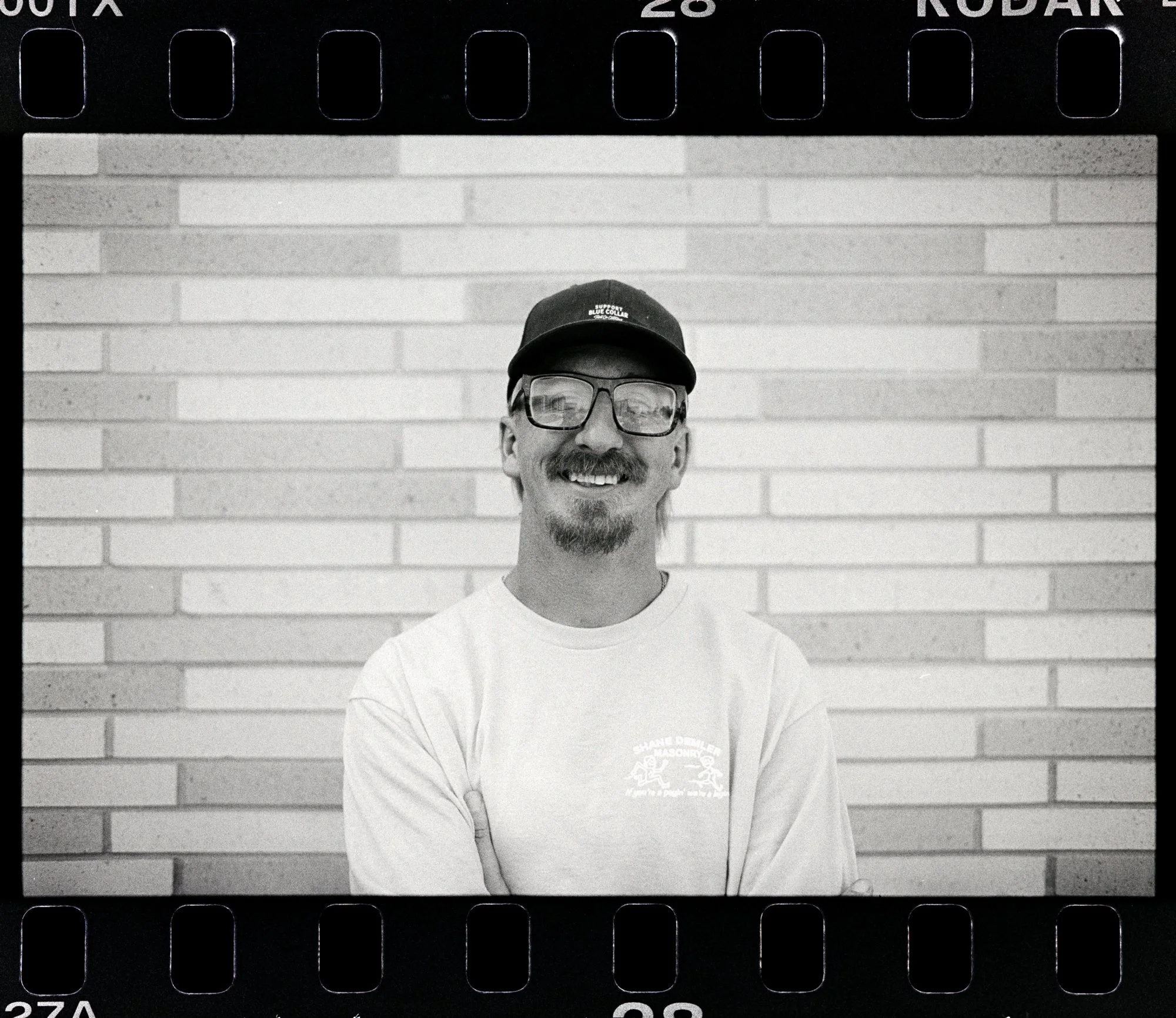
Portrait shot on 35mm Kodak Tri-X 400 film with Leica R6.2.
Jessie Demler is a foreman at Shane Demler Masonry, based in Cache County, Utah.