Earn My Bones
A profile of Zach Fox, working superintendent, Grade Tech Power Services
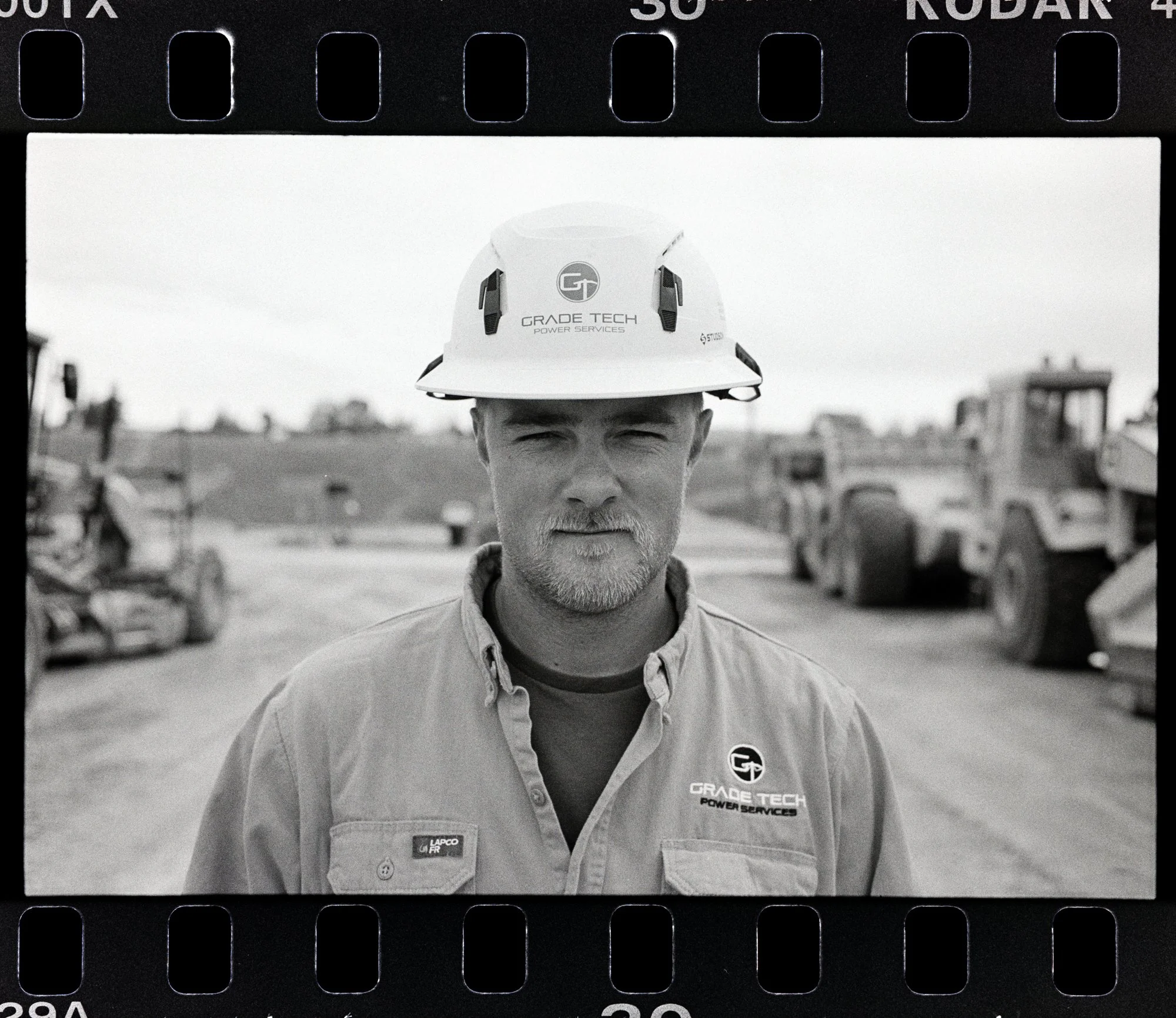
Portrait of Zach Fox. Captured on a housing development project in Kemmerer, Wyoming, August 2026. Shot on 35mm Kodak Tri-X 400 film with Leica R6.2.
“I like moving dirt so much, I just go to different states and keep moving it.”
So far, that’s 12 states. Zach Fox is 25 and a working superintendent at Grade Tech Power Services, a civil subcontractor in the power industry. He’s been with the company six years, going on seven, and he started as a laborer.
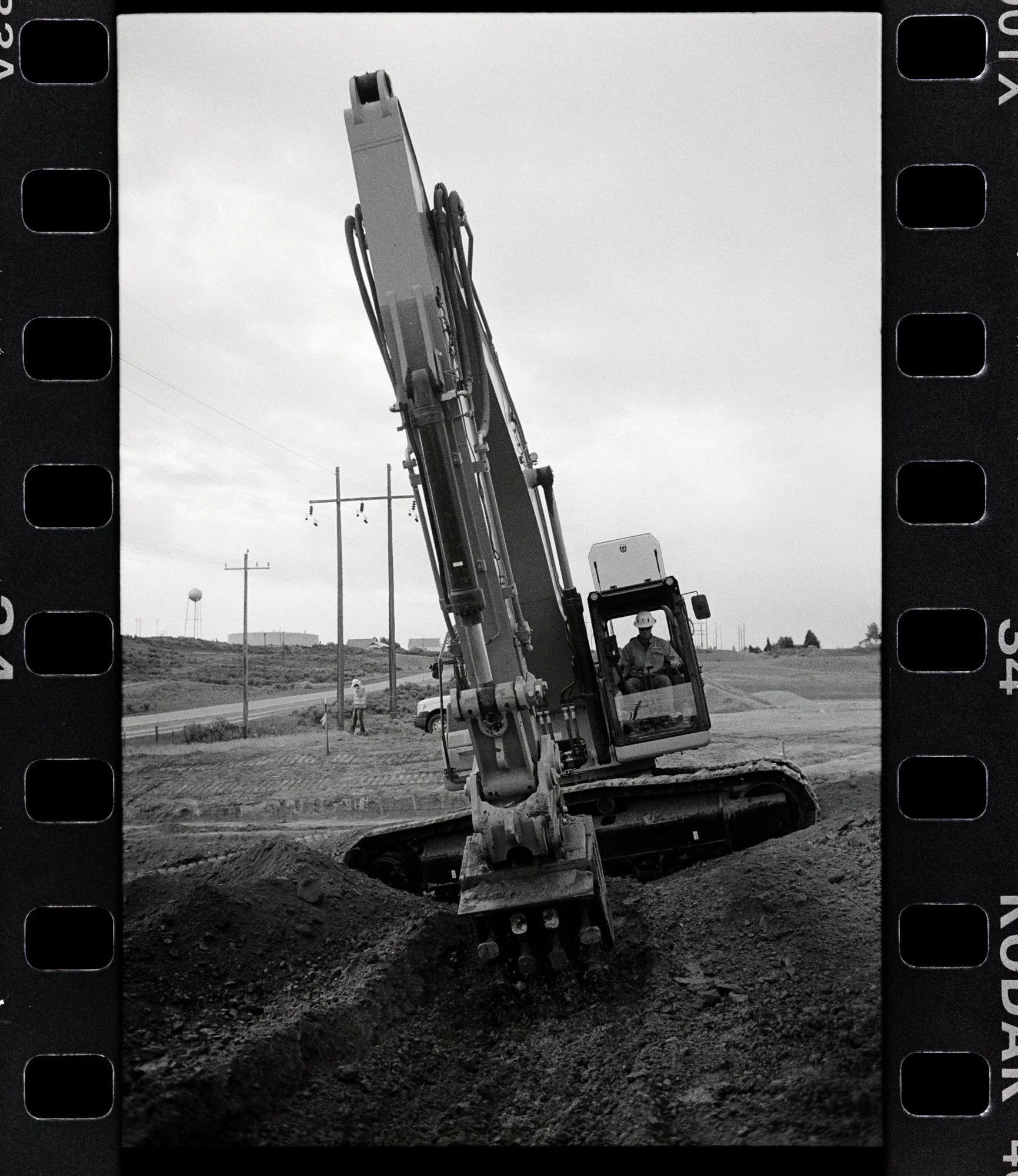
“Really had to earn my bones, work my way to the top, but took a little bit of time. But now I just mainly run these scrapers and dozers and do a little fine grading in the grader.”
He grew up in South Jordan, in the Salt Lake area, and now lives in a small town in Southern Utah. “Had to get out of the big city,” he says.
Following the Work
Part of the reason he travels for work is money. The other part is not being stuck building out the same place for years.
“The real answer is there ain’t no money in town and no benefits, but it’s just nice that you’re not tied on the same subdivision, the same city blowing up. For example, Herriman, Utah. There’s guys that have been there for 10 years developing that whole city.”
His current job is in Kemmerer, Wyoming, about two hours from Grade Tech’s headquarters. The crew is building the infrastructure for a new subdivision going in ahead of the nuclear power plant coming to town.
“There’s going to be over 270 houses in this little valley, but first phase is 80 homes. So we’re taking care of all the pipe, dirt work, road grading, curb and gutter, asphalt.”
A Family Trade
Before Grade Tech, Zach was an electrician.
“I was an electrician for five years all the way through high school and a couple years after high school.”
It was the family trade. His grandpa was a lineman for years, and he has an uncle and cousins in electrical work.
“Kind of just fell into my lap. I mean, it’s been a family trade. My whole family’s electricians, linemen, but just ended up following in their footsteps and realized I didn’t like it that much.”
Running heavy equipment suited him better, and the working conditions were a big part of it.
“I’m not working on a ladder 10 hours a day, [and] it’s air conditioned in the cab.”
The bigger issue was where he saw electrical work taking him.
“When I was an electrician, I felt stuck for a lot of years... I just couldn’t see myself making a living or having a family, buying a house.”
At 19, he left electrical work and started at Grade Tech as a laborer. The opening came through a high school friend.
“Honestly, I had a good buddy of mine throughout high school and his dad proposed it to us, so he kind of hooked it up for us and we just took a chance.”
Chasing the Blue Collar Dream
He counts himself lucky to have figured out early what he wanted.
“I got the money bug, that’s for sure. Chasing the blue collar dream.”
To him, that dream is pretty straightforward.
“Make money. Good hourly rate. That’s better than sitting at a desk. I can’t do that. I can’t sit down some same spot for 12 hours, eight hours, you name it. No way.”
School felt the same way. “It’s like sitting through school. I didn’t enjoy going to school that much, so I decided not to go to college.”
When the conversation turns to the trades as a whole, he goes straight back to that decision.
“I’ll be right honest with you. I’m not good with vocabulary and fancy words, but honestly, our public schools, all I heard growing up is ‘go to college, go to college, go to college.’ But I’m honestly number one believer in not going to college. You don’t have to go to college.”
His own story is the proof he points to.
“When I started this job, I could barely make my truck payment and [had] 200 bucks in my pocket. [I] didn’t know when [the] next paycheck was coming in, but after that, two years of this, I was able to buy my first home, get out of the city, buy my house... But I tell everyone, I’m living proof. You don’t got to go [to college].”
He’s proud of the path, and careful about how he frames it.
“I’m not saying college is a bad thing by any means, but it’s just one of those things that it is possible and it’s something people should talk about is that you [can] make a living in the trades and a good one.”
The Same Goal
Past the travel, the best part of the job for Zach is the people.
“Honestly, it’s relationships you make with people. When I was an electrician, [it was] more just show up, wire something, move on with your day, right? But here, there’s a lot of relations to make and people you get to know them fairly well. I’m with some of these guys more [than] my own family, so you get to know everyone pretty good.”
He says the crew is made up of people chasing the same thing.
“It’s definitely a lot of like-minded people, long days, long hours, you’re away from home, so everybody has a goal out here and that’s to achieve something, if it’s buy their first house or buy that new truck, anything, but we all have the same goal.”
That goal, he says, is “financial freedom. Not living paycheck to paycheck.”
A lot of the people running Grade Tech came up the same way he did. What he learned from them starts with the basics.
“It’s really just the fundamentals of just respect and showing other people respect. I learned a lot of stuff from one of our other superintendents about finances, funny enough, how to manage your money, buying your first house, what to look for.”
For Zach, respect comes down to one rule.
“One of our foundations here at Grade Tech is speak how you want to be spoken to.”
The work has changed him, too.
“I wasn’t really a patient guy when I first came over here. I learned how to talk to people, communicate, communication skills is a big thing, but patience. I really learned how to be patient with some people.”
There’s one thing he makes sure new hires understand.
“Working at Grade Tech, you got to have a career mindset. That’s another thing I tell a lot of the new hires. It’s not a temporary summer job. It’s kind of like working in the major leagues when you’re working around all this power.”
Room to Climb
Zach’s own climb went through every rung. He started as a laborer, then became an operator, then junior foreman, a position he describes as a foreman’s assistant, then foreman, and now working superintendent.
He isn’t the only one. The guys he came up with have made the same kind of climb.
“I mean, all of us have moved up. There’s a good group of guys that work here. We all started about five, seven, eight, nine years ago and not one of us is where we started.”
For someone who has never set foot on a job site, he says the opportunity is there for anyone willing to learn.
“Sky’s the limit out here. Pick up and run with it.”
Leave It at the Job Site
The hours are long. Most weeks the crew works six days, and a lot of the jobs are far from home. “Got to be a provider somehow,” he says. He has a wife and a kid at home who just turned 2, and being a dad is “the best thing ever.”
Being away from them is part of the deal.
“Obviously being away from your family, that’s a challenge, but I mean, that’s probably my biggest one when you’re gone this long and working this many hours... It’s not a whole lot of fun. It’s a whole lot of work, but it pays off at the end.”
On the hard days, whether it’s a rough job or bad weather, he holds himself to one rule.
“I try not to take work home with [me] really. Once I leave the job site, I leave it here and pick up in the morning. That’s my biggest goal, is not to take work home with me.”
Why It Matters
Zach has a quick answer for why people outside the industry should care about the trades.
“The world will stop... I mean, look at Salt Lake City, where I grew up, that valley’s tripled in the last 10, 15 years. So I mean, that’s the biggest thing with construction. Without it, it’s just like truck driving. It’ll affect the chain somehow.”
The power side of his work is no different.
“We got to keep up. I mean, you think about Teslas charging electric vehicles, hybrid vehicles, all of it. It all comes down together. I mean, big warehouses, all of us charge our phones every day. We use the air conditioner. Yeah, it’s crucial. It’s crucial.”
For anyone thinking about getting into earthmoving, his advice is short.
“You either love it or you hate it. You got to love it. You got to love what you do.”
As for what’s next:
“I’ll probably still be working here, to be right honest with you. We’ll ride it out and see what happens.”
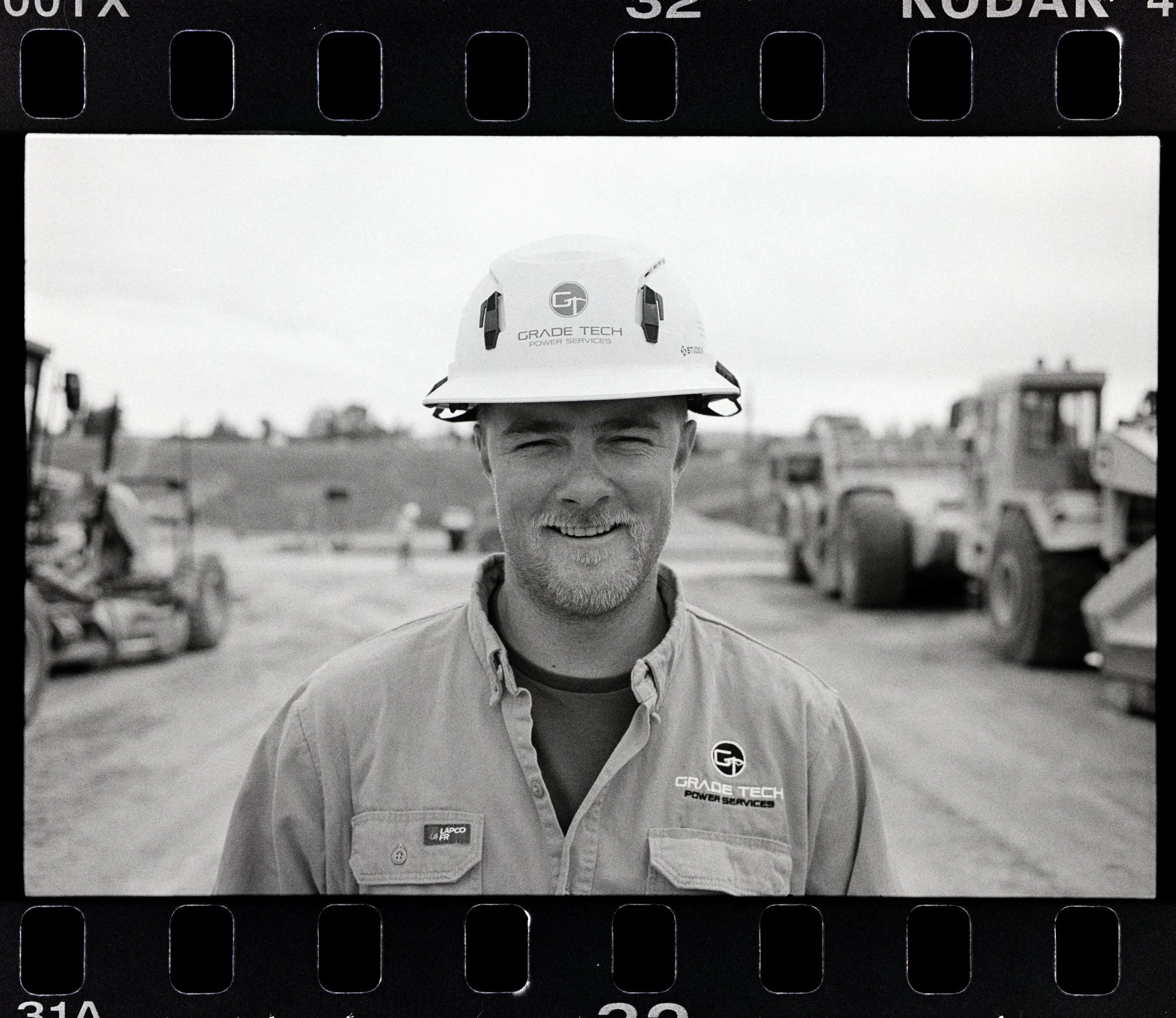
Portrait shot on 35mm Kodak Tri-X 400 film with Leica R6.2.
Zach Fox is a working superintendent at Grade Tech Power Services and lives in Southern Utah.