He’s Proud of Me
A profile of Cecilia Cruz, safety representative, Milburn Demolition
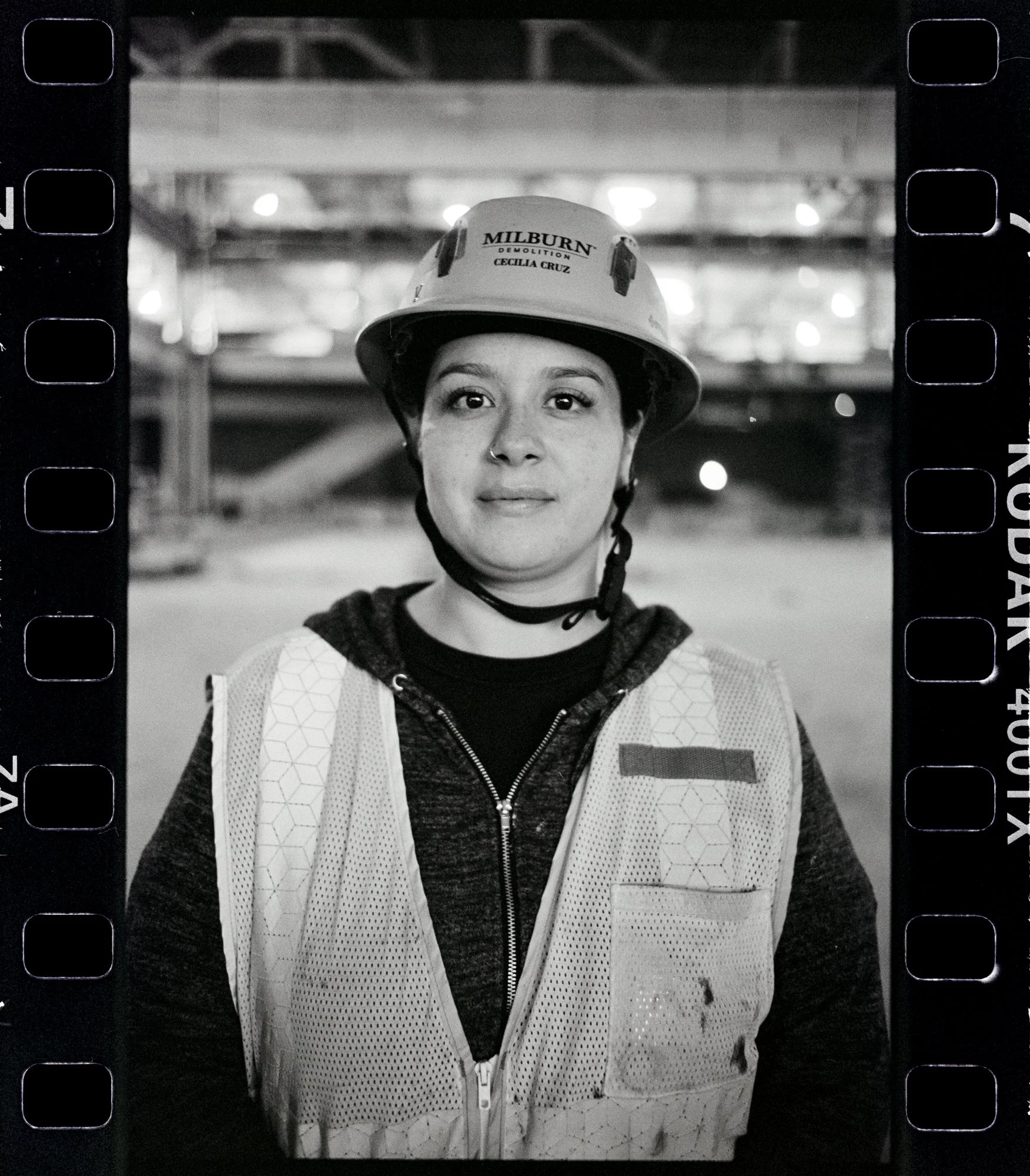
Portrait of Cecilia Cruz. Captured in downtown Chicago on an interior demolition project. October 2026. Shot on 35mm Kodak Tri-X 400 film with Leica R6.2.
“Your life can definitely change in a few minutes. People say from one day to another, but honestly it could happen in a few minutes.”
For Cecilia Cruz, those minutes came after work one day, when her husband decided to stay and hang out with some friends.
“He got onto an ATV. He had never got on one. He got on it and he crashed into cars. It was a very big hit, and he had a traumatic brain injury.”
He survived the crash.
“He has no motion. He can’t walk. He can’t talk. He can’t really move his arms. So he’s disabled.”
The accident also put Cecilia on a path she never pictured. She left a medical practice where she worked with sleep apnea patients and went into demolition at Milburn, the company where her husband had worked.
One Income
“It completely changed our lives. And that’s when I realized I had to do something about it, something not just for my family, but something for me as well. I realized it was going to be one income for a while. I didn’t know how long it was going to be for.”
Talking with her husband takes work, and she’s had more practice at it than anyone.
“He’s doing good. Since I was there for him through the whole process, you know, therapy after his accident, I’m able to understand him a little bit better than anybody else would be able to. There are times where I do have a hard time having a full conversation with him, but I try to have the patience and say, ‘Okay, give me the letter. What does it start with?’ And then I’ll go down the alphabet and that’s how we get through it.”
They still get out together.
“I’m still able to take him out in a wheelchair, get him a haircut, take him out to eat, do different activities. It does get challenging sometimes with certain restaurants or outings.”
While she’s at work, his mom and sister take care of him, and the three of them work out among themselves who’s with him and when.
Willing to Grow
Cecilia wanted her husband to keep getting the benefits Milburn offered, so she went to the company herself. She talked to Don Collier, Milburn’s principal and director of field operations, who already knew what her family was going through.
“I spoke to Don. I let him know, ‘Hey, you know what? These are my circumstances. Obviously you’re aware of them. I never imagined me being in this type of field, but I’m willing to grow. I’m willing to learn and I’m ready for it.’ And he said, ‘Okay, we’ll go ahead and take you on.’ And that’s how it started.”
She started as a laborer and found more room to move up than she expected.
“Once I joined the trades and I got here, I realized that there’s a lot more space for growth and I started learning a lot. I feel like you learn every day here, to be honest with you. And I started getting more responsibilities. I started learning from different people, different laborers, different foremen, and I just love what I do now.”
That growth led to a promotion.
“I am a safety representative with Milburn. I was actually just promoted about a month ago and I’ve always liked the safety aspect of this. I actually started doing a little bit of safety a few years back and I feel like I’ve grown a lot and therefore I can take on more responsibilities now.”
Her favorite part of the job has less to do with tearing things out than with the people doing it.
“My favorite thing is just working with everybody as a team and understanding how they do the job and why they do the job the way they do it. I like working with people that are patient, that kind of analyze what the task is and how it’s going to get done prior to just going into it and tackling it.”
Stop What You’re Doing
“Even though I’m a safety representative, I’m still a laborer as well. So I do help around and I do still work as a laborer.”
Her new role adds a safety emphasis and extra safety responsibilities. She helps the crew with toolbox talks and PPE and makes sure each task on the project gets done safely. The main message she gives the crew is simple.
“My biggest thing is that I tell the guys, ‘You want to make sure you go home to your family the way you came in.’”
If someone doesn’t understand how important it is the first time, she stops them.
“Stop what you’re doing right now and think about what you’re doing. Would you want your wife or somebody that you love, your son or your kid to do what you’re doing right now? Do you think it’s safe? What can happen to you right now?”
Confident With Myself
Being a woman in the field came with its own challenges, especially at the start.
“It was more difficult in the beginning because I’ve never worked with so many men. I’m the only girl in this company out here in the field. And so I feel like a lot of them were like, ‘You don’t even know what you’re doing. Why are you stopping me from doing what I’m doing?’ And I told them, ‘Look, yes, I’m your coworker and yes, you probably think I don’t know anything, but what I do know is that what you’re doing right now is not safe and I wouldn’t want my husband and I wouldn’t want my dad or any family member to do what you’re doing right now because I want them home, safe.’”
Over time, she stopped letting it get to her.
“I’ve learned to be confident with myself because I feel like we all go through a lot in our lives, and we learn that we can take on a lot and we grow strong from that. If my life changed from one day to another and I was able to adjust to it, I can do whatever.”
Stay Calm
Demolition rarely goes exactly to plan, and Cecilia has learned how to handle that.
“I like when there’s challenges. I learned to stay calm and I’ve also learned that when there’s something that happens that we know we have no control over, you just need to calm down and just let it be. Because if you continue to stress yourself and at the end you know that there’s nothing you can do to change it, why stress yourself? Just let it happen.”
She gives an example from the job.
“If the elevator goes down and you were supposed to dispose of material or bring a machine up or bring a machine down and it’s not going to happen because it [the elevator] broke down, there’s nothing you can do about it. So you just keep going and bring up another task that we can do. There’s always something to do.”
It’s How You Ask
The bigger challenge, she says, is the gap between generations on a crew.
“I’m working around a lot of men that are now in their 50s and they’re soon going to retire from this field. So they’re used to this being a certain way. And there’s a lot of newer, younger people coming into the trades that don’t really know too much. So these older men, they sometimes get a little frustrated. And I’ve had to be the person to tell them, ‘Okay, well if they’re not doing it the way you want them to do it, then teach them how to do it.’ Because at the end of the day, we’re working as a team.”
A lot of it comes down to how things get asked.
“They get mad real quick and sometimes they’re like, ‘Oh, I told this guy to clean up after me. He needs to clean this area and he’s not listening.’ ‘Well, how did you tell him? How did you ask him?’ If you were to be like, ‘Hey, you know what? We need to clean this area because if we clean this space, it’ll be easier to bring the gondolas,’ he’ll be like, ‘Okay, let’s do it.’ It’s all about how you talk to people. If you respect people, they’ll respect you back.”
Some of the guys have their own theory about why the crew listens to her.
“They always tell me, they’re like, ‘Oh, it’s because you’re a girl and that’s why they listen to you.’ No, it’s not. It’s because of the way I ask them to do things.”
She traces it back to her dad, who owns a body shop.
“I think he’s the one that taught me to be more calm and taught me how to talk to people. He has his own business, so he interacts with people on a day-to-day basis.”
She started working for him when she was very young.
“He would have me answer phones and he would have me do his payroll as well. I’ve always liked customer service. Looking back now, I think I learned it from him.”
I Demo Buildings
Her current job is in downtown Chicago: the interior demolition of a former trading center, a building with an open trading floor, being gutted so it can become a data center. Big projects like this one are the kind she likes most.
“I love big projects because I like to see when we start how it looks and then at the end it’s so much different. You’re like, ‘Wow, we did all this. We demoed all this and this is what it is now.’”
On being blue collar:
“I love it. I love it. I think it’s funny as a girl or a woman when they ask you, ‘What do you do for a living?’
“And you’re like, ‘Oh, I’m blue collar. I work in demo.’
“It’s funny because they’re always like, ‘Oh, so you build houses?’
“‘No, I don’t build houses. I demo buildings.’
“‘No way, you don’t do that!’
“I’m like, ‘Yeah, I do that.’ So then I have to sometimes even show them videos or pictures because they will not believe me.”
Part of it, she figures, is how she looks off the clock.
“I dress girly out of work, because I love working in what I do, but I feel like I look like a man [at work]. I look like a guy. So it’s nice on the weekend to get dressed up and actually feel like a woman or look like a woman.”
For women thinking about the trades, her advice is honest about how hard it is and still pushes them to go.
“I would let them know that it’s going to be challenging and if they’re up for a challenge to do it. I would also let them know that there’s a lot of space for growth in this field. I never imagined myself growing from a laborer to a safety representative and I would like to continue growing, so I would let them know to do it. If they think that they will be able to ignore the people around them and what they’re telling them, then they should go for it.”
A Good Route
Five years into work she never planned on, she talks about what it has done for her.
“It’s helped me be more confident with myself. It’s made me realize, one, there are things in life that you never expect will happen, and two, you never know where life will take you at the end. I always thought I was going to be in the medical field. My goal was to eventually become a nurse at a hospital. I’ve never thought I was going to be in the trades, but I like it. I like the challenges and you learn something every day.”
As for what’s next:
“I’m excited to see where life is going to take me, because like I said, you don’t really know. I could think now like, ‘Oh, later on, I’m going to be a safety director, that’s what I want,’ but you really don’t know if that’s what’s going to happen. I mean, I could say maybe years from now, maybe I’ll be Milburn safety director once Yeye [Rosales, Milburn’s current safety director] retires, but I’m not sure. Maybe life will take me somewhere else.”
Then there’s her husband, and whether he’s proud of her.
“When I let him know that I had been promoted to safety representative, he actually got very emotional. He’s like, ‘That’s good. You’re going through a good route. That’s really good.’ He always wished he was a foreman for Milburn. So I think him seeing that I’ve grown, I definitely do think he’s proud of me.”
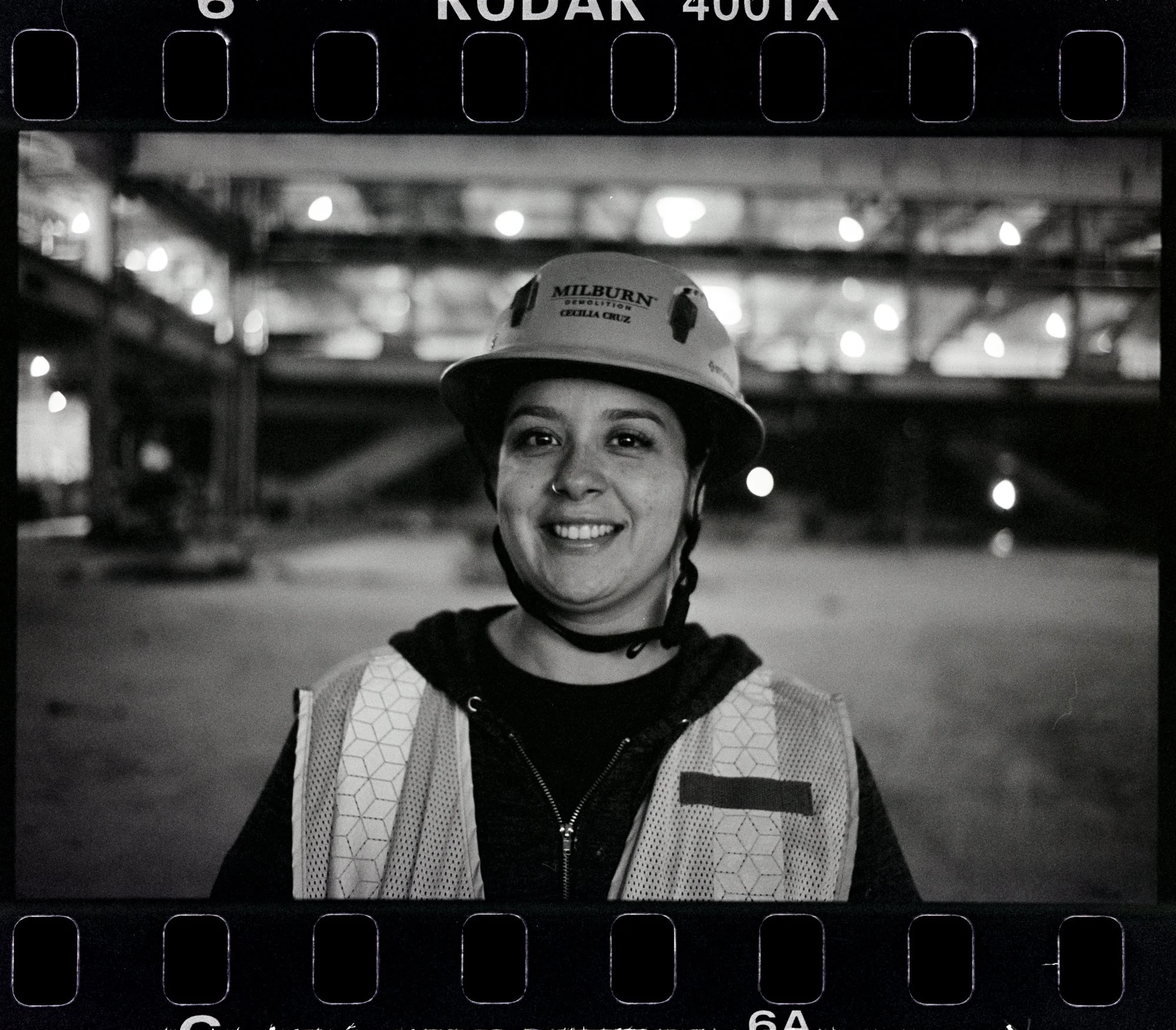
Portrait shot on 35mm Kodak Tri-X 400 film with Leica R6.2.
Cecilia Cruz is a safety representative at Milburn and lives in Chicago.